
TL;DR:
- Entry-level job postings have dropped dramatically, not because of mass layoffs, but because AI is “deleting” the tasks that used to justify junior roles.
- The old playbook (spray-and-pray applications, relying purely on degrees) is dead. Employers are expecting mid-level output for entry-level roles.
- The solution: Use AI to accelerate your output, build a portfolio of tangible projects instead of just a resume, and specialize in managing AI rather than just using it. The first rung of the ladder didn’t disappear—it moved.
Maya graduated in May with a 3.8 GPA, a relevant internship on her résumé, and a portfolio she’d spent two semesters building. By September, she had submitted over 200 applications for various positions, including AI entry-level jobs. She received four interviews. Zero offers.
She didn’t do anything wrong. The market changed underneath her while she was in class.
This isn’t a story about laziness or entitlement. It’s about something more structural — and more unsettling. The entry rung of the career ladder isn’t being downsized. It’s being deleted. And the graduates arriving to claim it in 2026 are finding nothing but air.
If that lands close to home, read on. Because there is a way through — but it requires an honest diagnosis first.
The Numbers Don’t Lie — But They Do Surprise
Let’s start with what’s actually happening. When it comes to AI entry-level jobs, the media narrative tends to swing between panic and denial.
AI is suppressing new hiring — especially entry-level — more than it is eliminating existing positions. That distinction is critical. Your employed colleagues aren’t getting fired en masse. But the roles that would have been created for you? Those are quietly disappearing.
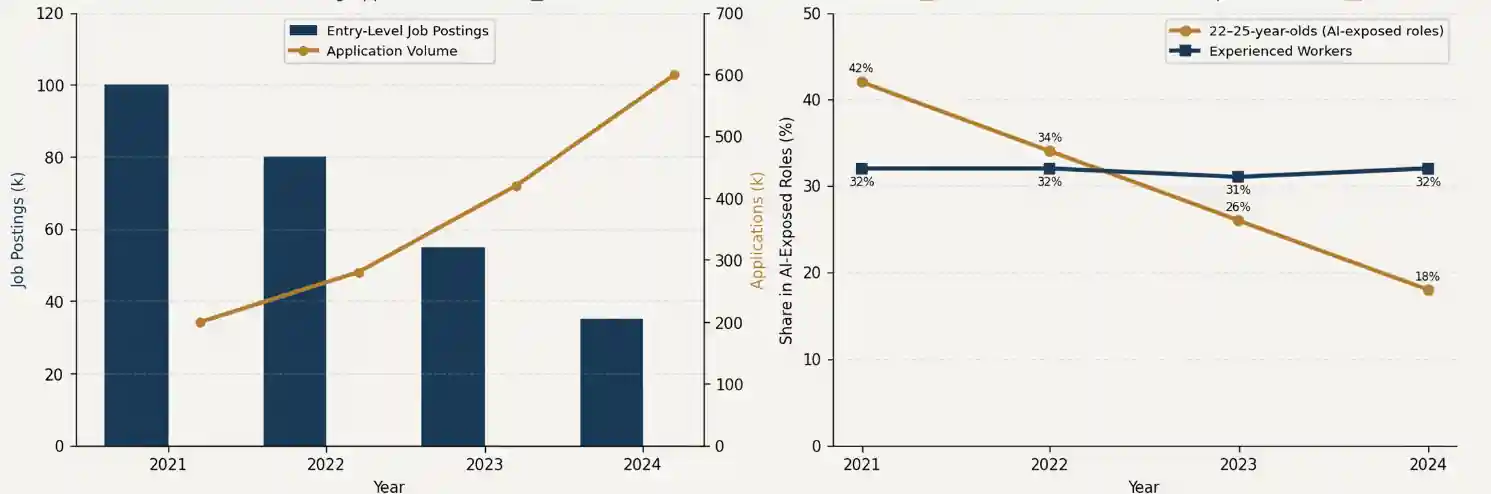
Entry-level job postings have dropped 15% year over year. Meanwhile, applications per posting rose 26 to 30 percent. More competition. Fewer openings. Basic math — and it’s brutal.
Unemployment among recent college graduates is 5.6%, lower than the 7.8% for young workers without a college degree but higher than that for adults overall (4.2%). And here’s the stat that should silence anyone claiming this is just a “normal cycle”: Oxford Economics determined that graduates — those age 22 to 27 with a bachelor’s degree or higher — have contributed 12% to the 85% rise in the national unemployment rate since mid-2023. Those graduates make up only 5% of the total workforce.
Why This Crisis Is Different From Every Recession Before It
Every generation gets told their job market is uniquely terrible. Most of the time, that’s self-pity dressed up as analysis. This time, something genuinely structural is happening.
Previous recessions hit broadly. What’s happening now is surgical. Early-career workers are the primary absorbers of AI-driven hiring reductions.
The mechanism is important. Companies aren’t cutting junior software engineers loose in waves. They’re simply not adding the junior roles in the first place, fundamentally changing the landscape of AI entry-level jobs by routing the summarizing, formatting, and boilerplate coding work that used to train new hires straight into a model instead.
“The entry-level job wasn’t just a paycheck. It was the trade: you do the rote work, the company gives you proximity to senior people, you absorb tacit knowledge over time, and eventually you become valuable enough to move up. That bargain is now broken at step one.”
There’s also a maddening irony baked into the job listings themselves. Employers have restructured them, loading junior postings with senior-level skills like judgment and stakeholder management, a shift researchers now call “seniorization.” You’re supposed to be entry-level — but you’re expected to already know everything that entry-level work was supposed to teach you.
The Playbook That No Longer Works
If you’re doing any of these things, you’re playing by rules that expired around 2024:
 Spray-and-pray applications: Sending 200 identical applications is a lottery ticket, especially when AI tools are sitting on the other side of the table screening your resume.
- Waiting for the right role to match your degree: The market does not currently care about your major in the way your campus career center implied it would.
- Treating credentials as your primary asset: A degree proves you finished something hard. It no longer proves you can do the job.
- Fearing AI instead of using it: The graduates getting hired right now aren’t the ones avoiding AI to protect their “authenticity.” They’re the ones working alongside it.
The New Playbook: Five Moves That Actually Work
Know Which AI Entry-Level Jobs Are Actually at Risk
Not all entry-level is equally at risk. High-risk zones right now include data entry, junior legal research, basic content writing, and entry-level financial analysis.
Lower-risk zones? Roles requiring physical presence, regulated professional judgment, and deep human trust — healthcare, skilled trades, client-facing advisory, and cybersecurity. A smart career move isn’t retreating; it’s reading where the solid floor is.
Use AI to Perform Like a Mid-Level Hire
The “learning curve” is being automated. But flip that around: if the learning curve is being automated, you can use that automation to climb it faster than any previous generation could.
Junior candidates who walk into interviews with AI-assisted research briefs or independently shipped code aren’t entry-level anymore — they’re demonstrating mid-level output. You answer the experience paradox not with time, but with leverage.
Micro-example: Instead of submitting a generic cover letter, use an AI agent like Claude or ChatGPT to analyze a target company’s recent earnings call transcripts. Identify their top three strategic challenges, and submit a 2-page brief proposing how your specific skills could help solve one of them. That isn’t entry-level behavior—that’s mid-level initiative.
Build a Portfolio That Proves Output, Not Potential
The credential signal has weakened. The output signal has strengthened. Hiring managers are flooded with identically formatted resumes from candidates with identical credentials. A document that proves capability beats a bullet point that claims it, every time.
Specialize in AI Management, Not Just AI Use
Here’s where most career advice stops short. Everyone is telling graduates to “learn AI.” That advice is already too generic. Half the applicant pool knows how to prompt ChatGPT.
What very few people know is how to manage, evaluate, and take professional responsibility for AI output. Companies urgently need people who understand AI’s failure modes, can handle exceptions, and can bridge the gap between what AI generates and what a real business needs.
Going further: You can start by familiarizing yourself with foundational concepts through free resources like Google’s AI courses or Coursera’s introductory modules. However, if you want to move beyond basic literacy into actionable product leadership, you need structured validation. Pathways like the AIPM Certification Pathway at APD Institute offer a curriculum specifically designed to bridge AI literacy and real-world product management—providing the kind of credential that signals genuine operational capability, not just surface-level familiarity with tools.
Compress Time With Targeted Human Networking
In a market where AI tools generate thousands of applications per minute, a warm referral is geometrically more valuable than it was three years ago. The goal isn’t to “network” in the vague sense; it’s to build visible signal in a noisy market.
Where the Doors Are Still Open for AI Entry-Level Jobs
The narrative of total collapse is wrong, and it does real harm. IBM, for instance, is actually tripling its entry-level hiring in the U.S. in 2026. However, their HR officer revised the descriptions for these jobs so they were less focused on areas AI can automate (like rote coding) and more focused on people-forward areas like engaging with customers.
According to IT hiring data, the vast majority of hiring managers report continued difficulty finding candidates with the right skill sets, particularly in AI, cloud, cybersecurity, and data.
The doors that are open are simply labeled differently. These aren’t consolation prizes. They’re the growth sectors of the next decade.
The Uncomfortable Truth Worth Saying Out Loud
The crisis surrounding AI entry-level jobs is real. But the response from most graduates — more applications, better formatting, LinkedIn optimization — is just a slower version of the same wrong strategy.
The workers getting hired aren’t outrunning AI. They’re the ones who learned to work alongside it, direct it, and take professional accountability for its output. That is now the minimum viable competence for the bottom of the career ladder.
“The ladder didn’t disappear. The shape of the first rung changed.”
The question isn’t “how do I find an entry-level job?” anymore. The better question is: what skills make me genuinely useful at a time when AI can handle the basics?
The first rung moved. Find where it landed. Get on it.
Which of these five moves do you think is the most underrated right now? Have you tried building a portfolio outside of traditional tech roles? Drop it in the comments — the most interesting answers tend to come from people already in the middle of navigating this.