
The AI Product Manager Job Posting That Started an Argument
She had eight years of experience. A portfolio of launched products. A LinkedIn profile that practically glowed. Yet, when interviewing for an AI product manager role, she didn’t get the job.
The candidate who did? Four years in. No MBA. But she’d shipped an LLM-powered feature end-to-end, understood how to write specs around probabilistic outputs, and had opinions about evaluation metrics that the hiring panel hadn’t even thought to test for.
The rejection note to the first candidate was polite but pointed: “We need someone who builds with AI, not someone who manages around it.”
This wasn’t a fluke. It wasn’t a startup being precious. It was a signal — one that’s showing up across the industry with increasing clarity.
The PM role hasn’t just “changed.” It has split. And the salary gap between the two sides is already well into six figures.
The Split Nobody Officially Announced
Here’s what most career guides won’t tell you: there is no longer a single thing called “product manager.” There are two distinct archetypes now operating under the same job title, and the gap between them runs past $150,000 a year.
Understanding which side of that line you’re on — or building toward — is arguably the most important career decision a PM can make right now.
The AI-Powered PM is a generalist who has embedded AI deeply into how they already work. They’re not just opening ChatGPT to paraphrase meeting notes. They’ve rebuilt their workflows: AI for user research synthesis, AI for competitive analysis, AI-assisted PRD drafting, AI for sprint retrospectives. 73% of product managers now use AI tools weekly or daily — but within that group, there’s a wide spectrum between “I use it sometimes” and “I’ve redesigned my entire operating rhythm around it.”
The AI-Focused PM (AIPM) is a specialist. They build AI products. They manage ML features, navigate the intersection of data science and user experience, and hold product accountability over systems where the output is probabilistic, not deterministic. An AI product manager is responsible for turning AI capabilities into useful, reliable, and business-ready products. They don’t just ask “Can we build this?” — they ask “Should we build this? How should it work, and what value will it create?” In practice, they work across product strategy, customer needs, technical constraints, and business outcomes.
Then there’s a third group: the PM who has done neither. Still running the same playbook from 2021. Still treating roadmap ceremonies as the core of the job. Still thinking “AI strategy” means adding a ChatGPT integration to the backlog.
That’s the group at risk.
AI Product Manager Salary: The Numbers Don’t Lie and The Gap Is Wide
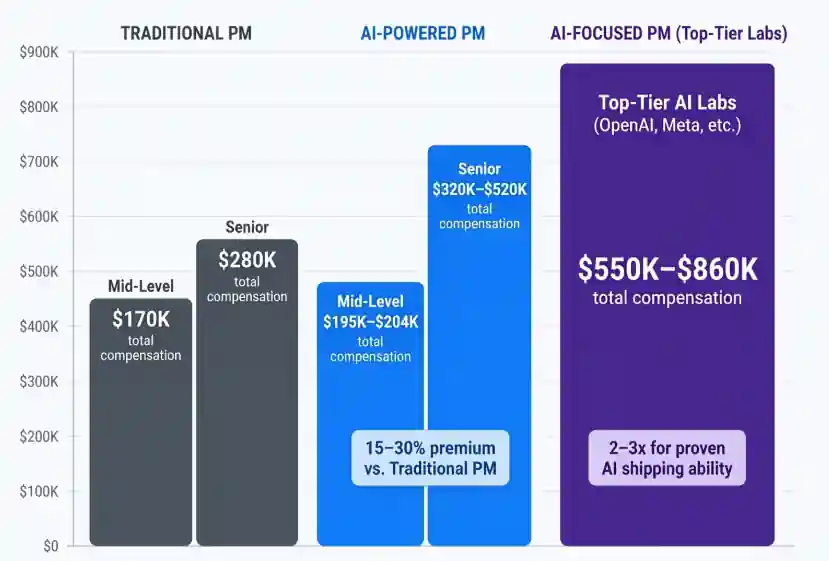
Let’s put specific numbers to what an AI product manager earns compared to traditional counterparts. Based on projected market data, including insights from the KORE1 AI Product Manager Salary Guide, the compensation comparison is where the gap becomes visceral:
- Mid-Level Traditional PM: ~$170,000 total compensation.
- Mid-Level AI PM: ~$195,000 to $204,000 (A 15–20% premium over generalist counterparts).
- Senior Traditional PM: ~$280,000 total compensation.
- Senior AI PM: $320,000 to $520,000 total compensation.
- Top-Tier AI Labs (OpenAI, Meta, etc.): Total compensation reaching $550,000 to an astronomical $860,000.
Compensation has risen sharply since 2022. By 2026, the role commands a clear premium over traditional PM roles — typically 15–30% higher at every level, and even more at senior levels.
And the forecast? The AI PM premium will partially compress as the candidate pool grows — expect the 15–30% premium to narrow to 10–20% by 2028. But here’s the catch: the spread between top performers and median performers will widen, with companies increasingly willing to pay 2–3x for proven AI shipping ability. The average premium may shrink. The ceiling will keep rising.
Why the Gap Exists — and Why “Using ChatGPT” Won’t Close It
There’s a tempting, comfortable story circulating in PM circles: just learn some AI tools and you’ll be fine.
It’s not wrong. But it’s not the whole picture.
For an AI product manager, the compensation gap reflects deeper technical demands: understanding model behavior, training data tradeoffs, and writing product specs around probabilistic outputs instead of deterministic features. When your product’s core behavior can shift with each model update, the job description changes fundamentally.
There’s also a risk asymmetry that hiring managers understand viscerally. A misaligned roadmap on a traditional SaaS feature wastes engineering cycles. A misaligned AI product strategy can burn months of compute time, annotated training data, and customer trust in a single quarter. Companies that have been burned once are not hiring on instinct. They’re paying for demonstrated fluency.
For AI-powered generalists, the productivity advantage is just as real. According to a recent McKinsey Global Survey, generative AI has ramped up product manager productivity by 40%. One PM, Aakash Gupta, documented his own results in granular detail, showing how he reduced his weekly operational and execution tasks by roughly 80%. Research synthesis dropped from 8 hours to 1 hour; competitive analysis from 6 hours to 30 minutes; and early prototyping was cut from days to mere hours.
Instead of miraculously working zero hours, he reinvested those 20+ freed-up hours into deep strategic work, user interviews, and cross-functional alignment. PMs who capture that productivity compound it into strategic output. PMs who don’t are simply slower — and the market is noticing.
This isn’t AI replacing PMs. It’s AI-fluent PMs replacing AI-resistant ones.
The Market Has More Jobs — and They’re Harder to Fill
Here’s the paradox that makes this moment particularly interesting: product management job postings were up 14% year over year, yet companies continue to describe hiring as unusually difficult.
The jobs exist. The qualified candidates don’t — at least not in the shape companies need. Drawing on recent industry data tracking KORE1 AI Product Manager Salary Guide posted in the US, nearly half are Manager-level, and only 2% are junior. Companies are hiring people to own product direction, not to support someone else’s roadmap.
And this isn’t just a Silicon Valley FAANG phenomenon. Traditional sectors—finance, healthcare, retail, and manufacturing—are desperately seeking PMs to lead their digital and AI transformations. In these non-tech enterprises, an AI-fluent PM isn’t just a cog in a machine; they are a rare asset capable of driving massive business value, making it even easier to stand out and command leadership roles.
Negotiation has more leverage for an AI product manager than a traditional role, because supply is tight. That’s a rare sentence in any job market.
The Door Is Open. But It Won’t Wait Forever
Here’s the part that gets buried under anxiety: this transition is learnable.
PMs who already have deep user empathy, product strategy instincts, and cross-functional communication skills have a massive head start. Those aren’t soft advantages — they’re the foundation that technical AI literacy gets built on top of. Quality control of AI output and critical thinking are exactly the PM superpowers needed right now.
The question is whether you combine them with AI fluency, or let the combination happen in someone else’s career instead of yours. That hesitation from the majority is a gift to the PMs who move now.
What It Actually Takes to Cross the Line
No hand-waving. Three moves that actually matter.
1. Go from AI tool user → AI workflow designer. There’s a difference between reaching for AI when you’re stuck and systematically rebuilding your workflows around AI by default. Map your week. Identify the five tasks that consume the most time. Build repeatable, AI-assisted systems for each. Make it systematic, not sporadic.
2. Get literate in what’s inside the box. You don’t need to train models. But if your product involves ML or AI, you need to be able to hold a real conversation about model drift, hallucination risk, confidence thresholds, and evaluation metrics. The fastest way to build that literacy is direct exposure — read ML team post-mortems, sit in on model evaluation reviews. Curiosity compounds.
3. Build and ship something AI-native. The credential that moves markets right now isn’t just a line on a resume. It’s a live product or a working proof of concept. Even a side project counts. Building teaches you more about becoming a successful AI product manager than any amount of reading, because you’ll hit the real friction: ambiguous outputs, evaluation gaps, and the specific hell of writing acceptance criteria for a system that doesn’t always behave the same way twice.
Fast-Tracking Your AI Product Manager Transition
You can absolutely piece this knowledge together through trial, error, and late-night reading. But for those who want to skip the frustrating guesswork and structure this transition deliberately, you don’t have to figure it out alone.
Programs like the AIPM Certification Pathway are designed specifically to bridge this gap. It provides a clear, structured route to developing exactly the skills the market is rewarding—taking you from a traditional PM to a certified AI product leader equipped with the AI literacy, strategic frameworks, and technical fluency that hiring managers are actively screening for.
Frontier Professionals refuse to outsource their thinking; they know long-term success means continuing to build human skills and not letting them atrophy. That’s the archetype worth building toward.
The Only Question That’s Still Open
The split has happened. The salary gap is in the data. The job postings are live. The hiring criteria have already shifted.
When a role is being redefined in real time, the people who move decisively are the ones who get to define what the next version of it looks like — and what it pays.
The job title may stay the same.
The paycheck won’t.
Which archetype resonates most with your current role — AI-Powered PM, AI-Focused PM, or still figuring out the difference? Drop your take in the comments. The more honest you are about where you sit today, the more useful the conversation gets.