
Introduction
When AI can autonomously generate code, what remains of software engineering’s core value? Will code reviews become obsolete? Are senior engineers facing replacement? And is there still a future for junior developers?
Recently, senior engineering leaders from major tech giants convened in a closed-door seminar to confront the fundamental disruption AI brings to software development. The outcome wasn’t a straightforward roadmap, but rather a “map of the future” fraught with fault lines.
This newly released report from the seminar distills 10 core insights that every tech leader and developer needs to understand.
1. Quality Hasn’t Disappeared; It Has Shifted
When AI takes over the actual coding, where does engineering rigor go? The answer: it moves upstream and outward.
Shifting to Specifications: If AI writes code based on your requirements, the requirements themselves become your greatest point of leverage. Garbage prompts yield garbage code; consequently, the focus of review is shifting from code to specifications.
Shifting to Test Suites: The report highlighted a golden rule: TDD (Test-Driven Development) is the ultimate prompt engineering. Writing tests before the code exists prevents AI from “cheating” (i.e., writing tests that merely validate incorrect behavior). Tests are now the anchors of deterministic validation, rendering the generated code itself essentially “disposable.”
Shifting to Type Systems and Risk Tiering: Utilize strong typing and strict constraints to make incorrect code “unrepresentable.” Simultaneously, code should be tiered by its “blast radius” (e.g., internal tools vs. external services vs. mission-critical systems) to determine the necessary level of validation.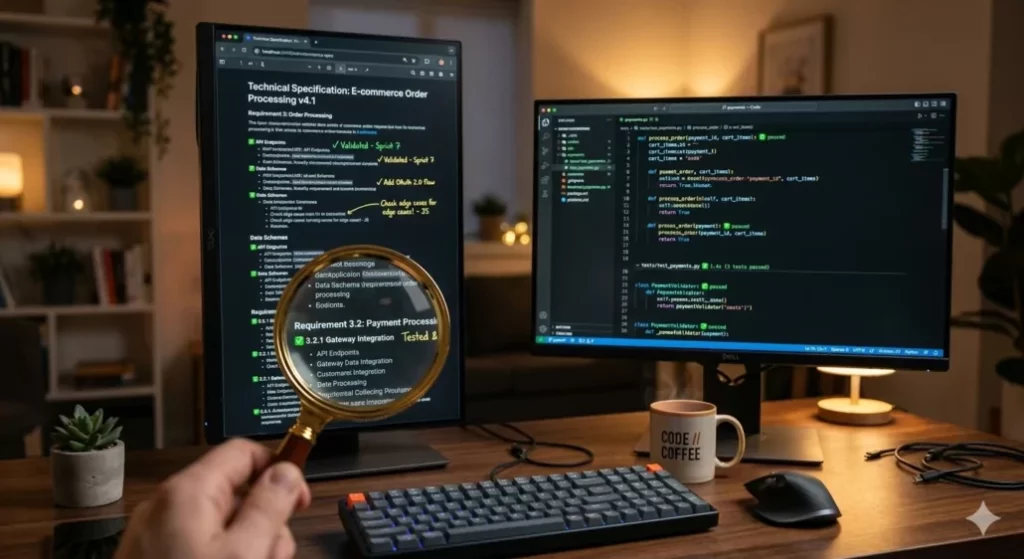
2. Code Review is Dead; Its Four Functions Need New Homes
Traditional code review is being unbundled. The four core functions it once carried—mentorship, consistency, correctness, and trust—must now find new places to live.
-
Where does mentorship go? It may require regular architecture retrospectives or mob programming.
-
Where does consistency go? It is now enforced by type systems and automated linters.
-
Where does correctness go? It is guaranteed by highly robust test suites.
-
Where does trust go? This remains the hardest challenge, likely requiring entirely new metric models.
3. The Birth of the “Middle Loop”: An Unnamed New Discipline
In the past, software development was divided into the “inner loop” (writing code) and the “outer loop” (delivery and ops). Now, a new supervisory layer has emerged in the middle: guiding, evaluating, and remediating the output of AI agents.
This demands an entirely new skill set: decomposing problems into AI-digestible work packages, calibrating trust in AI outputs, and maintaining architectural cohesion across massive streams of AI-generated code.
Those who stubbornly insist they were “hired just to write code” may face obsolescence, much like engineers hand-rendering polygons in 1992. The future’s true value lies in orchestration and oversight, not manual implementation.
4. Conway’s Law Still Holds, But Now It Governs “AI Employees”
System designs invariably mirror an organization’s communication structures. Now that AI agents are team members, new challenges arise:
Velocity Mismatch: AI can clear a backlog in days, only to hit a brick wall of cross-team dependencies and architectural reviews that still move at human speed. The primary bottleneck has shifted from “capacity” to “decision-making.”
Agent Drift: Database agents deployed with identical initial configurations will gradually develop different “habits” and patterns after working with separate teams. Should we actively manage this drift, or simply embrace it?
Decision Fatigue: When middle managers realize AI generates work faster than they can possibly approve it, they themselves become the bottleneck. Do we still need such a thick layer of middle management?
5. Self-Healing Systems Sound Beautiful, But We Aren’t There Yet
Letting AI automatically remediate production incidents? The prerequisites for this are still lightyears away.
The first hurdle is “tacit knowledge.” Senior engineers troubleshoot incidents relying on years of internalized pattern matching (e.g., “If you see this error code, check the connection pool first”)—knowledge that has never been formally documented.
For AI to learn this, we must build an “agent subconscious”—a system that learns from years of incident reports to provide historical context. Until then, robust rollbacks, feature flags, and stellar observability are far more reliable than letting AI blindly patch code in production.
6. Productivity and Experience Are Decoupling, and Developers Are Suffering
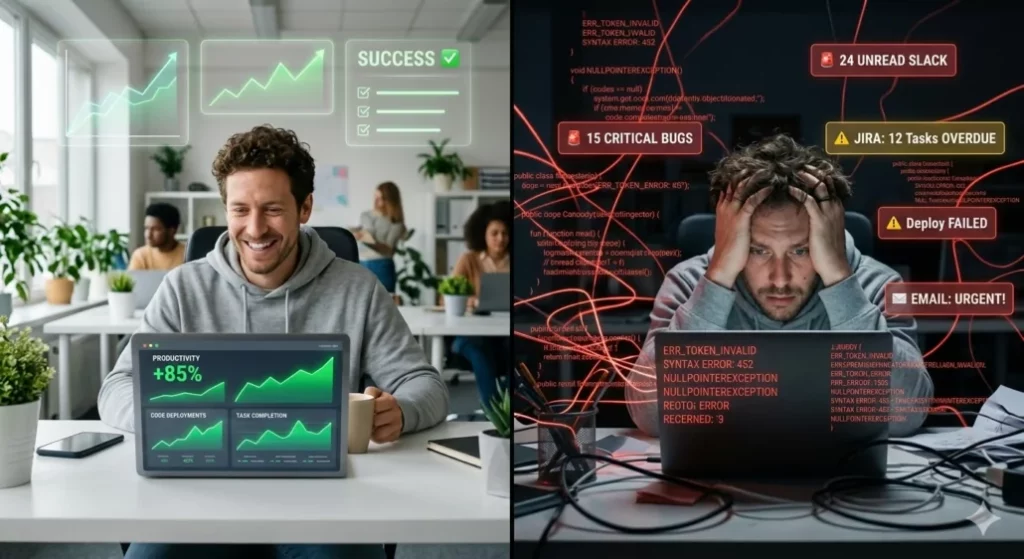
A terrifying paradox has emerged: organizations are achieving higher output with AI tools, yet developers are left feeling more dissatisfied, grappling with heavier cognitive loads, and experiencing fewer states of flow.
When productivity is no longer tied directly to user experience, companies lose the incentive to invest in “Developer Experience” (DevEx). A sharp piece of advice: reframe it as “Agent Experience” (AgentEx)—because the very conditions that allow AI to operate smoothly are exactly what humans need to thrive as well.
7. Senior Engineers Face New Pains, While Juniors Gain Immense Value
Senior Engineers: They are more crucial than ever, possessing the broad vision and architectural acumen needed to supervise AI. However, they are also the most miserable, as their time is heavily drained by interpersonal coordination rather than technical oversight. Their roles must pivot to become “friction eliminators.”
Junior Engineers: AI fast-tracks them through the novice phase, making them more productive than ever before. They are the industry’s ultimate “call options” for the future.
The True Danger Lies with Mid-Level Engineers: Having grown up during mass hiring sprees, they may lack technical depth and are by far the hardest cohort to retrain.
8. Security: The Most Overlooked Minefield
At the seminar, security sessions had the lowest attendance, perfectly reflecting the industry’s prevailing mindset: ship the tech first, figure out security later.
But the risks introduced by agent permissions are fatal. Grant an agent email access, and it can reset passwords and hijack accounts. Give a dev tool full-machine access, and you’ve effectively handed over the keys to the kingdom.
Future security must be secure-by-design, standardized across the industry, and AI-driven to keep pace with the sheer velocity of modern attacks.
9. Agile Isn’t Dead, But Governance Must Catch Up
Those shouting “Agile is dead” are gravely mistaken. In reality, some teams are compressing sprints into a single week, utilizing AI to automate reviews and reporting.
The real threat is governance. When development accelerates, it violently collides with the stubbornly sluggish processes of approval, compliance, and finance. Without reforming governance, Agile will simply hit the wall faster.
Another piece of bad news: because AI can effortlessly generate massive code changes, teams are reverting to “large-batch releases.” This flies in the face of DORA metrics, which have spent decades proving that “small batches mean greater stability.” Consequently, system stability is steadily declining.
10. The Unsolved Mystery: Who Are We, Really?
The seminar concluded by leaving behind a slew of questions that should keep the entire industry awake at night:
If the roles of Product Manager and Developer are converging, what do we call this new hybrid role?
When code mutates faster than human comprehension, how do we preserve institutional knowledge?
Can we—and how do we—trust a non-deterministic system where the exact same inputs yield entirely different outputs?
If the velocity of human decision-making is the new bottleneck, do we simply have to… slow down?
Conclusion
This closed-door session didn’t offer a unified vision of the future, but it did map out invaluable fault lines, showing us exactly what is collapsing and what is being reborn.
For every professional in the software industry, the imperative is not to predict the future, but to understand the trajectory of change and position oneself accordingly. Those most adept at charting new maps are usually the ones humble enough to admit how much they still don’t know.