
The Capability Divide for Product Managers in the AI Era
Core Judgment: AI will not replace product managers, but it will eliminate “execution-oriented product managers”—as well as those decision-makers who believe that merely using AI tools equates to a successful transformation.
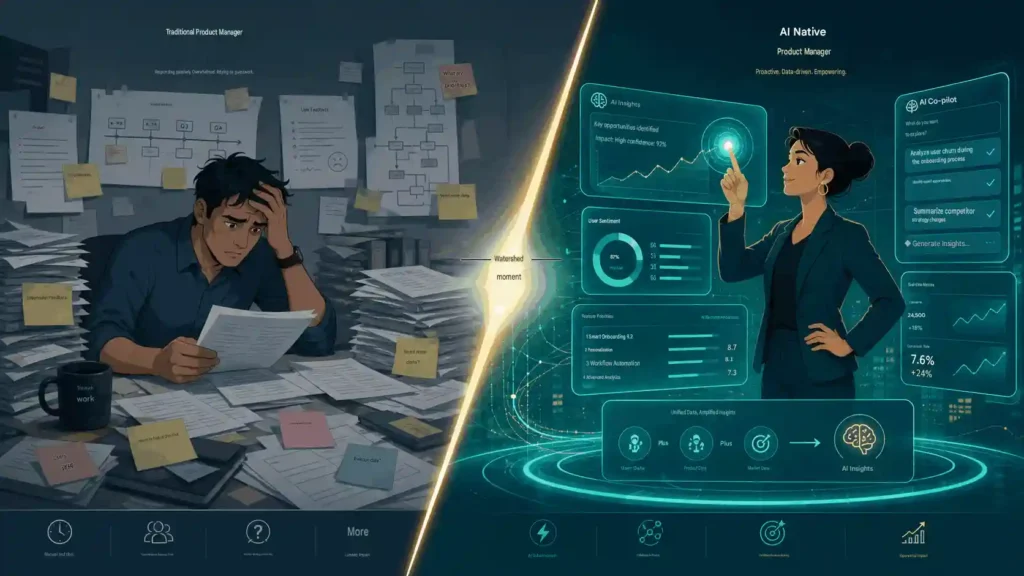
Prologue: One Conference Room, Two Vastly Different Outcomes
This is a real scenario that took place in an internet company.
Background:
The company was developing an AI customer service product for small and medium-sized enterprises (SMEs). During the requirement review meeting, two product managers presented their respective proposals.
Product Manager A (8 years of experience, traditional path):
Presented a 60-page PRD (Product Requirements Document, the core file describing product features and logic), detailing the interaction logic of every page, complete with flowcharts. He spent 3 days on competitor analysis, interviewed 5 clients, and typed every single word in the document himself.
Product Manager B (4 years of experience, AI-native path):
Presented a 20-page document. She first used AI tools to complete the competitor analysis and user pain point summarization within 8 hours. Then, she spent the remaining 3 days entirely on one thing: repeatedly asking, “What should the core decision-making logic of this product be?”. She included a diagram in her document—a decision tree for the AI customer service under different confidence intervals (the degree of certainty the AI has in its answers), and designed the boundary rules for human-AI collaboration for each branch.
After the meeting, the CTO remarked: “A’s document is more complete, but B’s document is more valuable.”
This is the divide.
Chapter 1: AI Has Split the Product Manager’s World in Half
1.1 In the Past, What Was a Product Manager’s Moat?
Before the popularization of AI, an excellent product manager’s competitiveness stemmed from three areas:
① Information Asymmetry
“I understand users better than engineers, and I understand technical boundaries better than users.” This two-way translation ability made PMs irreplaceable in a team.
② Coordination Skills
Breaking down an ambiguous business goal into executable tasks for R&D, and aligning the work of over a dozen people in the same direction—this is a soft skill that requires significant time and experience to accumulate.
③ Documentation Skills
Translating chaotic requirements into clear PRDs and drawing complex logic into concise flowcharts. This is the fundamental skill of a PM, a hard skill many spend years mastering.
1.2 AI Has Punched Holes in All Three Walls
Here is a harsh truth that will make many product managers uncomfortable:
| Traditional PM’s Moat | To What Extent AI Can Achieve This |
|---|---|
| Information Asymmetry | AI can complete competitor analysis, user review mining, and industry report summaries within 1 hour |
| Documentation Skills | AI can directly generate a PRD draft, user stories, and test cases based on a single conversation transcript |
| Coordination & Communication | AI meeting minutes, AI task breakdown, AI email drafting… Communication costs have drastically decreased |
This does not mean AI can already “replace” PMs. Rather, it means: For those PMs who survive solely on these three skills, their irreplaceability is being rapidly eroded.
What does this mean for management?
A severe organizational issue:
How many PMs in your team spend over 60% of their daily work doing things that AI can already do to an 80-point standard?
1.3 The Essence of the Divide: From “Information Processor” to “Judgment Holder”
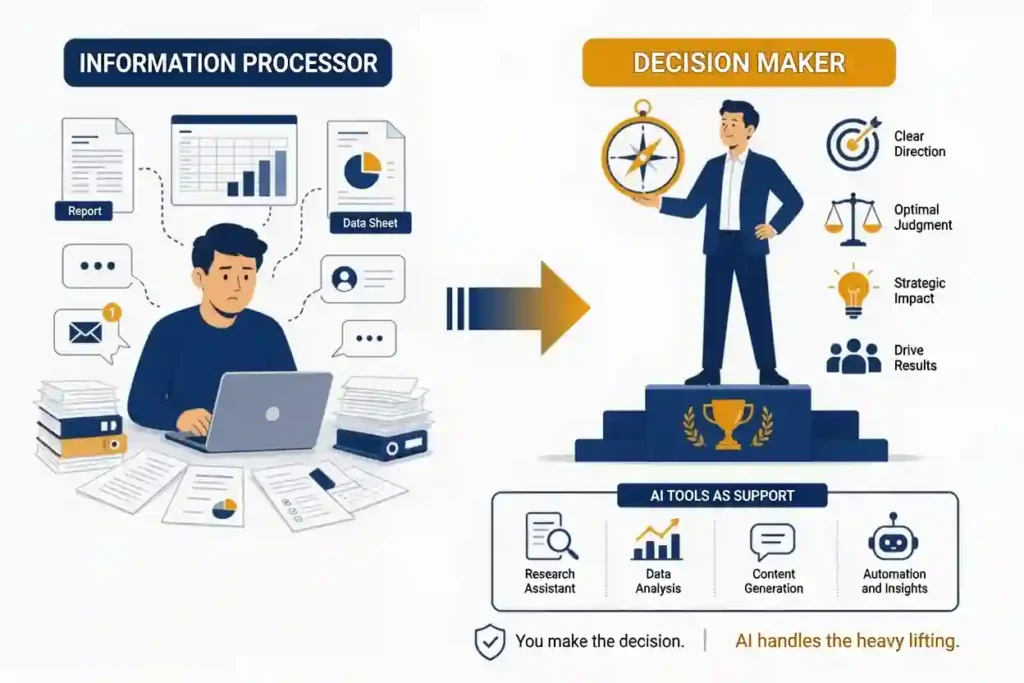
In the AI Era, the role of a PM has undergone a fundamental shift:
- Past: PMs were the porters and processors of information—collecting information → organizing information → transmitting information
- Present: AI has taken over most of the porting and processing work
- Future: PMs must be the holders of judgment—among the 10 options provided by AI, judging which 1 is worth executing and why
This shift is a threat to junior PMs, but an opportunity for management—because judgment is inherently the core asset of management.
Chapter 2: Five Capability Divides (Management Perspective)
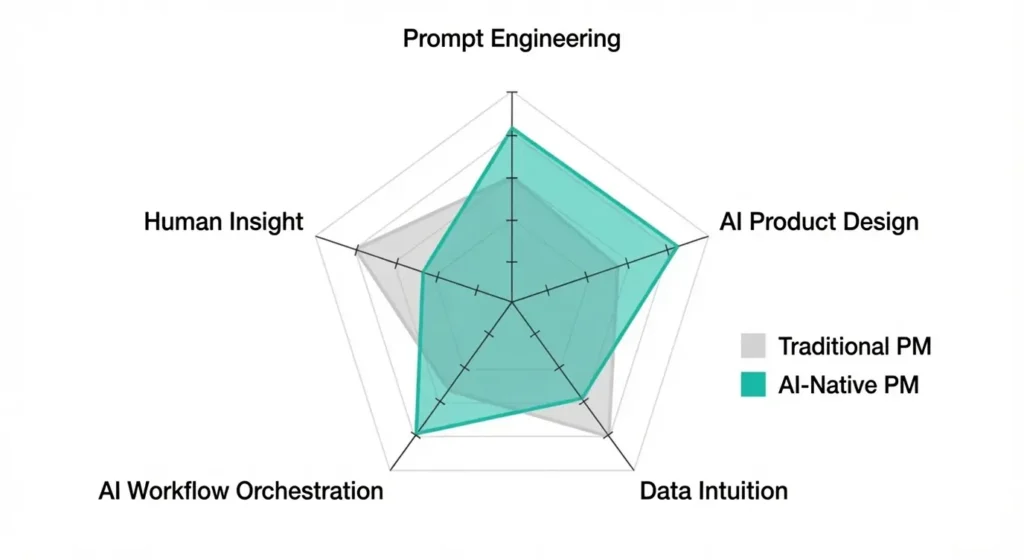
Let’s map out the core capabilities of a product manager on a radar chart (see image above).
The gray area represents the capability distribution of a traditionally excellent PM: strong documentation, strong communication, and solid requirements analysis.
The blue area represents the capability distribution of an AI-native PM: they may not be comprehensively superior in traditional skills, but across the 5 new divides, they have already established a generational gap.
Let’s break down these 5 divides one by one.
 Divide 1: Prompt Design Capability
One-sentence definition:
It’s not about knowing how to use AI tools, but being able to precisely direct AI to serve product decision-making.
Many managers see their teams using ChatGPT or Claude and assume the team “is already using AI.” But this is like saying, “The team bought Excel, so our data analysis capabilities are very strong”—the tool is there, but the capability might not be.
Bad Prompt vs. Good Prompt: How big is the gap?
Example Comparison:
Analyzing the same product decision: “Should we build an AI search feature?”
Inefficient Prompt: “Help me analyze whether we should add an AI search feature to our product”
Output: A bunch of generalized “pros and cons” that offer zero help for decision-making.
Efficient Prompt:
“You are a SaaS (Software as a Service) product strategy consultant. We are an ERP (Enterprise Resource Planning) system targeting manufacturing companies with under 500 employees, with an MAU (Monthly Active Users) of about 80,000, an average user age of 42, primarily operating on PC. We now need to decide whether to add an AI semantic search feature next quarter. Please provide a clearly opinionated recommendation, not a neutral analysis, from the perspectives of: ① actual user scenario value, ② R&D investment ROI (Return on Investment), and ③ competitor differentiation. Constraint: Do not generalize; provide 1 specific basis for judgment for each perspective.”
Output: An analysis with a specific inclination, logical reasoning, and direct applicability for discussion in a decision-making meeting.
Takeaway for Management: When evaluating a PM’s AI capability, don’t ask, “What AI tools did you use?” Ask, “What decision did you make using AI last week? How did you write the prompt, and what was the output?”
Divide 2: AI Product Design Capability
One-sentence definition: Knowing how to design a product experience where “humans and AI complete tasks together.”
Designing a standard SaaS feature and designing an AI feature are fundamentally two different things.
AI products present 3 design challenges that standard products do not:
Challenge 1: Designing for Uncertainty
Standard features are deterministic: a user clicks “Submit,” and the result is either success or failure. AI features are probabilistic: asking the same question 10 times might yield 10 different answers.
Product Question: When the AI’s output might be wrong, how should you design the product interface to help users establish the correct trust expectations, avoiding both over-reliance and complete distrust?
Challenge 2: Designing for Explainability
Why should a user believe an AI’s recommendation? In B2B (enterprise-level) products, this issue is exceptionally critical—no procurement director will ever tell their boss, “AI made this decision, and I don’t know why.”
Solution Direction: Make the AI output a triad of “Conclusion + Key Evidence + Confidence Level,” rather than just providing the conclusion.
Challenge 3: Fault-Tolerant Design (Error Handling Mechanisms)
AI making mistakes is an inevitability, not a probability. Product design must answer: When AI makes a mistake, can users easily correct it? Can the system learn from the error?
Divide 3: Data Intuition
One-sentence definition: It’s not about knowing how to query data, but being able to sniff out product opportunities or risk signals from the data.
There is a key distinction here:
- Data Capability (trainable): Knowing how to write SQL (Structured Query Language, used for database queries), use BI (Business Intelligence) tools for data visualization, and conduct A/B testing (comparative testing by randomly grouping users to test different schemes)
- Data Intuition (relies on experience and mindset): When seeing an anomaly in data, the first reaction is “What happened behind this?” instead of “Is this data correct?”
Test your PM’s data intuition with 3 questions:
Test Question 1: Your product’s 7-day retention rate (the percentage of users still using the product on day 7 after their first use) suddenly dropped from 32% to 21% last Wednesday. What is your first action?
 Answer without data intuition: Ask the data team to produce an analysis report
 Answer with data intuition: First ask, “What happened last Wednesday?”—Was there a new version release? Was there a channel marketing campaign? Were there any holidays? Use the process of elimination to locate the source of the problem, rather than waiting for a report
Test Question 2: The Click-Through Rate (CTR) of your AI recommendation feature is 18%, while the industry average is 15%. How would you report this data?
Answer without data intuition: Report, “Our CTR exceeds the industry average; performance is good”
Answer with data intuition: Probe further, “What is the conversion rate after the click? Did the user complete the target behavior after clicking? If an 18% CTR brings a massive amount of invalid clicks, it actually indicates a problem with the recommendation quality”
Test Question 3:
User research shows that 85% of users are “satisfied” with your product, but over the past 3 months, the DAU (Daily Active Users) has been continuously declining. How do you interpret the contradiction between these two metrics?
Answer without data intuition: Assume the survey is flawed or data collection is incorrect
Answer with data intuition: This is the classic “satisfaction trap”—user satisfaction does not equate to user reliance. We need to probe deeper: Which features are users satisfied with? Is the reason they stopped coming back that they found a substitute, or has their use case disappeared?
Takeaway for Management:
Building a culture of “data intuition” within a team isn’t about buying more expensive BI tools, but consistently asking one question at the weekly product meeting: “Is there anything in this week’s data that feels off to you?”
Divide 4: AI Collaboration Orchestration Capability
One-sentence definition: Being able to string multiple AI tools together into a Workflow, rather than using single tools in isolation.
A specific case:
A company’s product team conducts a competitor analysis. The traditional process is as follows:
Collect competitor info (1 day) → Organize and categorize (0.5 days) → Draft analysis report (1 day) → Internal review and revision (0.5 days) = Total approx. 3 daysAfter introducing an AI workflow:
① Use an AI search tool to automatically scrape the latest competitor updates (30 mins)
↓
② Use an AI assistant to extract key info based on a unified framework (30 mins)
↓
③ Use AI to auto-generate an initial comparative report (30 mins)
↓
④ PM manually reviews, focusing on supplementing the "strategic judgment" section (1.5 hours)
= Total approx. 3 hours
Time is compressed from 3 days to 3 hours.
The time saved is entirely invested in what AI cannot replace: strategic judgment.
Where is the divide?
| Tool User | Workflow Orchestrator |
|---|---|
| Encounters task → Opens AI → Asks question → Copies result | Encounters task → Invokes preset workflow → Reviews result → Focuses on judgment |
| AI is an occasionally borrowed tool | AI is a “virtual member” of the team |
| Efficiency increases by 10%~20% | Efficiency increases by 300%~500% |
Takeaway for Management: Don’t just ask the team, “What AI tools are you using?” Ask, “Have you linked AI tools into workflows? For every repetitive product task, is there a corresponding AI Workflow SOP (Standard Operating Procedure)?”
Divide 5: Human Insight
One-sentence definition: AI can provide answers, but only humans can ask the right questions.
Among the 5 divides, this is the only one where the stronger AI becomes, the more valuable this capability gets.
Why does AI fail at user interviews (the method of communicating deeply face-to-face with real users to understand their true needs)?
In user interviews, the most valuable information often lies not in what the user says, but in:
1. The user’s pauses and hesitation (indicating a sensitive point has been touched)
2. The helplessness in micro-expressions when the user says “it’s okay” (indicating the problem is more severe than they are willing to admit)
3. The way their eyes suddenly light up when mentioning an “unrelated matter” (indicating this is their true need)
AI can analyze 10,000 user reviews, but it cannot capture the information conveyed by a single frown from a user in an interview room.
Integrating into Scrum: Why can’t AI write the soul of a User Story?
In Scrum, the standard format for a user story is: “As a [user role], I want to [achieve a goal], so that I can [receive a specific value].”
AI can bulk-generate a massive amount of grammatically correct user stories. But behind a good user story, a PM needs to answer a question that AI cannot replace:
“What does this user truly care about at that specific moment?”
For example: In the scenario of “Enterprise HR using a payroll management feature,” AI will generate: “As an HR professional, I want to export payroll reports with one click, so that I can save time.”
However, a PM who has conducted in-depth user interviews will write: “As an HR professional who is temporarily asked to provide data 5 minutes before the boss’s meeting every month, I want the payroll report to be exportable within 30 seconds without any preparation, in a format the boss can understand, so that I won’t make a fool of myself in public at the conference room door.”
These two user stories will drive completely different product design decisions.
AI writes the first one. A PM who understands users writes the second one.
Chapter 3: Management Self-Test—Which Side of the Divide is Your Team On?
The following 10 questions are not aimed at individual PMs, but rather at the manager’s judgment of the team’s current status.
Please score each question: 0 points = Basically none / 1 point = A few are doing it / 2 points = The team is generally doing it
| # | Behavior Description | Score |
|---|---|---|
| 1 | The team has a standardized AI Prompt template library and continuously iterates and updates it | |
| 2 | When making product decisions, PMs proactively use AI as a “devil’s advocate” to challenge their own proposals | |
| 3 | The team can clearly describe the “confidence boundary” and human-AI collaboration rules for each AI feature | |
| 4 | During product reviews, the first drafts of competitor and data analysis are completed by AI, and PMs’ time is primarily spent on judgment and decision-making | |
| 5 | The team has established evaluation standards for AI output quality, going beyond just “feels okay” | |
| 6 | In every Sprint, there is a dedicated validation phase specifically targeting the uncertainty of AI features | |
| 7 | The team’s user interviews do not rely on AI summaries; PMs can clearly describe the non-verbal information from the interviews | |
| 8 | PMs can independently build at least one AI workflow to handle repetitive product tasks | |
| 9 | When spotting data anomalies, the team’s first reaction is to formulate hypotheses, rather than waiting for a report | |
| 10 | When hiring PMs, AI collaboration capability is one of the evaluation dimensions, with specific assessment methods |
Score Interpretation:
| Score Range | Team Status | Management Advice |
|---|---|---|
| 16~20 points | AI-Native Product Team | Continue deepening; focus investment on AI product design capability and data intuition |
| 10~15 points | Team in Transition | Foundation exists, needs systematization—establish standard processes and evaluation systems |
| 5~9 points | Tool Usage Stage | Danger signals present—the team is using AI tools, but their capabilities haven’t upgraded |
| 0~4 points | Traditional Model Team | Immediate action required—this is not a technical issue, but a strategic one |
Conclusion: On Either Side of the Divide, Choice Outweighs Effort
Finally, a sobering truth that is genuinely useful for management.
In the AI Era, the polarization of product capabilities is essentially a polarization of two organizational choices:
Choice 1:
Treat AI as a cost-reduction tool—make PMs do more with AI to save manpower, but the PM’s capability model remains unchanged. This path is effective in the short term but dangerous in the long term. Because when your competitors’ PMs are already doing work that requires judgment, your PMs are still doing work that AI can do.
Choice 2:
Treat AI as a lever for capability upgrades—use AI to free up PMs’ time, and invest that time into judgment, user insight, and product decision-making, which AI cannot replace. This path requires systematic investment but will form a true competitive moat.
The most brutal truth of the AI Era is: It’s not the slow who lose to the fast, but those heading in the wrong direction who lose more tragically the faster they run.
The divide is not a technical threshold, but a choice of mindset.
This choice lies not with the PM, but with management—because a team’s capability ceiling is often the boundary of the manager’s cognition.