
Monday, 9:12 a.m. A message lands: “Here’s the market analysis — AI did most of it ;)” Thirty polished pages. Confident tone. Your job is to build the pricing recommendation on top of it, which means every wrong number inside now quietly carries your name.
You can’t trust it. You can’t redo it either. The workable middle is AI output validation: a triage discipline that matches how much you check to how much damage an error would do downstream.
Here is the playbook.

The Hidden Cost of Unreviewed AI Work
If this keeps happening to you, that is not bad luck. It is the statistical norm.
A January 2026 survey by Zety found that 66% of employees spend up to six hours or more each week correcting low-quality AI output — “workslop” — and nearly half quietly fix it themselves instead of pushing back. Glean’s Work AI Index 2026 names the flip side: workers spend 6.4 hours a week “botsitting”, and 69% of AI users admit they have passed along AI output without properly verifying it.
So the colleague who sent you those thirty pages probably is not careless or cynical. They skipped a step that most people skip. Which means the fix is not a complaint — it is a process.
Why You Can’t Trust It — and Can’t Redo It Either
The two obvious options are both bad. Blind trust means you inherit the blast radius. A full redo means you absorb the entire cost of work someone else already claimed as done — invisible labor that is quietly eating the productivity AI was supposed to create. Foxit’s 2026 State of Document Intelligence report puts hard numbers on this verification burden: end users save 3.6 hours a week with AI, then spend 3 hours 50 minutes validating output. Net gain: negative.
The way out is proportionality. Not every document deserves the same scrutiny. You validate to the level of risk, not to the level of your anxiety.
AI Output Validation: Triage Before You Trust
Before you read a single line, classify the handoff by how far the damage would travel downstream:
- Low — internal draft, easily reversible. Spot-check two or three claims, scan the structure, move on. Fifteen minutes.
- Medium — crosses teams or reaches clients. Verify every number, quote, and date; walk the core logic chain yourself. About an hour.
- High — external publication, financial figures, legal or compliance exposure. Line-by-line verification, written confirmation of sources, explicit escalation. Treat it as unverified until proven otherwise.
Most handoffs land in Low or Medium. Knowing that is what keeps validation cheap.
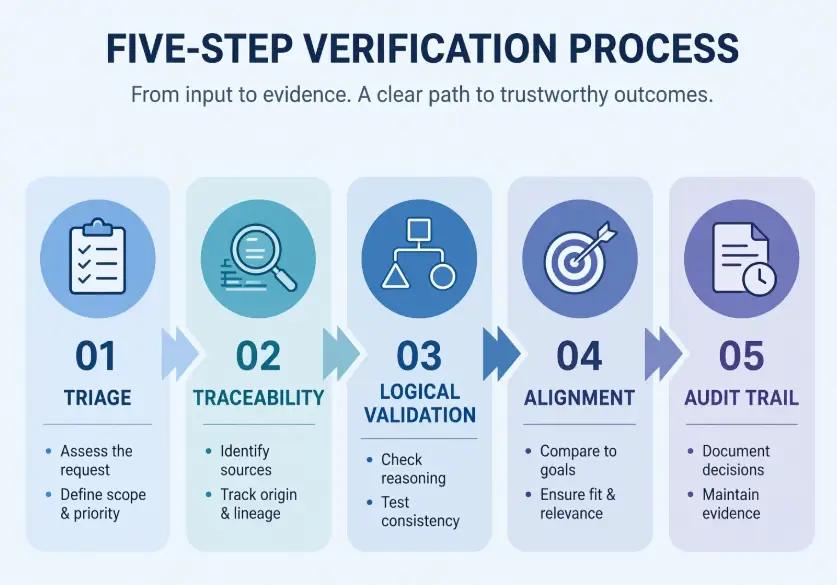
A 5-Step AI Output Validation Workflow
The following AI output validation workflow is calibrated for a Medium-tier handoff. Scale it up or down based on your triage.
1. Classify before you read. Decide the tier first — it caps how much time you are allowed to spend. Reading first is how fifteen minutes becomes an afternoon.
2. Trace every load-bearing fact. Numbers, quotes, dates, regulations, citations. Ask for the source of each one. No source, red flag. AI generates plausible specifics with complete indifference to whether they exist.
3. Stress-test the logic. AI is best at smooth transitions that hide broken reasoning. Pick the two or three arguments everything else depends on and re-derive them yourself. If the load-bearing logic holds, cosmetic flaws are cheap to fix.
4. Align with the sender — without accusation. The goal is information, not blame. “I’m building on this downstream — can you point me to the source for figure 12?” works. “Did you even check this?” buys you a defensive colleague and no answer.
5. Leave a trail. Record what you verified, what you assumed, and what you could not confirm. If a problem surfaces later, that trail shows exactly where the unreviewed work entered the pipeline — and that it was not at your step.
Make AI Output Validation a Team Standard, Not Your Personal Burden
Individual discipline caps the damage, but it does not fix the pipeline. Research from BetterUp Labs and Stanford’s Social Media Lab (September 2025 – March 2026) found that trust within a team reduces workslop by 61% — teams that talk openly about how AI output gets checked produce less of it in the first place.
Three practical moves: a shared AI output validation checklist; a “definition of done” for AI-assisted work (sources attached, assumptions listed); and a team norm that asking for sources is professionalism, not distrust.
This is also how the APD Institute’s AI-Native Professional Competency Model frames it: output validation and human review are not private habits of conscientious people — they are defined, assessable professional competencies.
From Cleanup Duty to a Certifiable Skill
Here is the reframe worth holding onto: as AI makes generation cheap, verification becomes the scarce skill. The person who can look at thirty confident pages and find the three wrong numbers is doing work AI cannot.
That skill now has a name and a standard. The AINP (AI-Native Professional) certification validates exactly this set of competencies — responsible AI use, output validation, and knowing when human review is non-negotiable. If you are already doing the work, it is worth holding the credential that proves it.
Next time the “AI did most of it ;)” message lands, you will not need luck. You will have a workflow.