
Today, as artificial intelligence permeates every industry, efficiently taking over a vast array of repetitive tasks—from code generation and requirement breakdown to progress tracking and automated reporting—voices within and outside the industry frequently claim that “managers will be replaced by AI” and “Scrum Masters will disappear.” However, returning to the essence of organizational dynamics and the core of leadership, human-centric coaching roles such as Team Leaders and Scrum Masters will by no means be replaced by AI. On the contrary, empowered by AI, they will unleash even greater value, becoming the most scarce and competitive core roles in the AI Era. This article delves into this perspective across five dimensions: the boundaries of AI capabilities, the irreplaceability of human nature, the essence of Agile, human-AI collaboration, and organizational value.
I. The Boundaries of AI Capabilities: Excelling in Efficiency, Lacking in the “Human” Element
The core advantages of artificial intelligence lie in data processing, pattern recognition, rule execution, and automation. It can analyze massive amounts of information, generate standardized solutions, and issue warnings for process risks within milliseconds, yet it will always have impenetrable boundaries. AI lacks self-awareness, emotional experience, value judgment, and moral responsibility, let alone the ability to comprehend complex human nature and organizational dynamics.
AI can output the optimal sprint plan, but it cannot read the fatigue and concerns of team members; AI can identify emotional keywords in communication, but it cannot perceive the subtle atmosphere in a meeting room; AI can provide conflict resolution strategies, but it cannot mend the cracks in trust between people; AI can execute process standards, but it cannot make gray-area decisions that balance rules and human empathy in ambiguous situations. As agreed by Scrum.org and numerous authoritative AI professionals: AI is an excellent process assistant, but a clumsy human coach. It can push “tasks” to the extreme, but it cannot unlock the potential of “people.” The core of team management and Agile coaching has always been about “people,” not “tasks.”
II. The Irreplaceability of Leadership: Core Human Capabilities AI Cannot Replicate
The value of leaders and coaches is rooted in four core capabilities that AI can never replicate, which also form the foundational pillar of their competitiveness.
First, deep empathy and the creation of psychological safety. Outstanding Scrum Masters and Team Leaders can capture unspoken needs, resolve hidden conflicts, and foster a safe environment where people dare to make mistakes. Psychological safety is the cornerstone of high-performing teams, and it can only be built by humans. AI can simulate empathetic expressions, but it cannot truly feel others’ emotions, nor can it build trust with genuine sincerity and warmth. When a team faces failure, members fall into confusion, or a project hits a deadlock, an understanding word, unwavering support, and an honest conversation carry a power that algorithms can never replace.

Second, gray-area decision-making and accountability in ambiguous situations. Business and R&D scenarios are fraught with uncertainty, where incomplete information, conflicts of interest, and value trade-offs are the norm. AI relies on data and rules and can only handle definitive problems; leaders, however, must make the final call, take risks, and balance short-term efficiency with long-term value in scenarios with no standard answers. From disputes over technology stacks to resistance against organizational change, from deadlocks in cross-departmental collaboration to conflicts over resource allocation, the ultimate decision and responsibility must be borne by humans. AI can offer decision-making references, but it cannot substitute human judgment and accountability.
Third, visionary inspiration and team cohesion building. The essence of leadership lies in inspiring goodwill and potential, converging individual goals into a shared mission. AI can break down tasks and allocate work, but it cannot tell compelling stories, transmit unwavering beliefs, or forge spiritual consensus within a team. True leaders can keep a team grounded in prosperous times and resolute in times of adversity. This influence, based on personal charisma and values, is impossible for algorithms to simulate.
Fourth, situational wisdom and dynamic adaptation. Management is not a standardized process, but an art tailored to people, events, and timing. An excellent coach can read the team’s lifecycle, identify members’ capability stages, and dynamically adjust their coaching methods. AI can output universal methodologies, but it cannot perceive the live situation, adapt to individual differences, or make flexible, on-the-spot reactions. This ability to “read the room” and adaptive wisdom are the crystallization of long-term experience and human insight, which AI can hardly acquire.
III. The Core Value of a Scrum Master: Returning to the Essence of Agile, Beyond AI’s Reach
The Scrum Master is positioned as a servant-leader, team coach, and obstacle remover. Their core work revolves around “people” and “collaboration,” which falls entirely into AI’s blind spot.
First, deep coaching and growth empowerment. The core value of a Scrum Master is not organizing meetings or updating burndown charts, but coaching the team towards self-management and continuous improvement. From guiding deep reflections in retrospectives to helping members break through their capability bottlenecks, from fostering a collaborative mindset to shaping an Agile culture—these tasks require long-term companionship and personalized guidance that AI cannot replace. AI can provide training materials, but it cannot customize coaching plans based on a member’s personality and current state.
Second, resolving complex obstacles and coordinating relationships. The hurdles faced by R&D teams are rarely just technical; they are often interpersonal and organizational issues such as cross-departmental silos, communication misalignments, resource conflicts, and cultural resistance. AI cannot navigate the balancing of interests, resolve interpersonal conflicts, or drive organizational change. The Scrum Master serves exactly as the bridge between the team and the organization, using communication, coordination, and influence to clear the obstacles that algorithms cannot touch.
Finally, grounding Agile culture and building antifragility. The core of Agile is “Individuals and interactions over processes and tools,” while AI, fundamentally, is a tool. Formalistic Agile can be automated by AI, but true Agile culture—openness, transparency, respect, and continuous improvement—must be guarded and passed down by humans. The Scrum Master must fight against “Zombie Scrum” and guide the team back to the true essence of Agile. Such cultural leadership and unwavering adherence to values constitute a mission AI simply cannot fulfill.
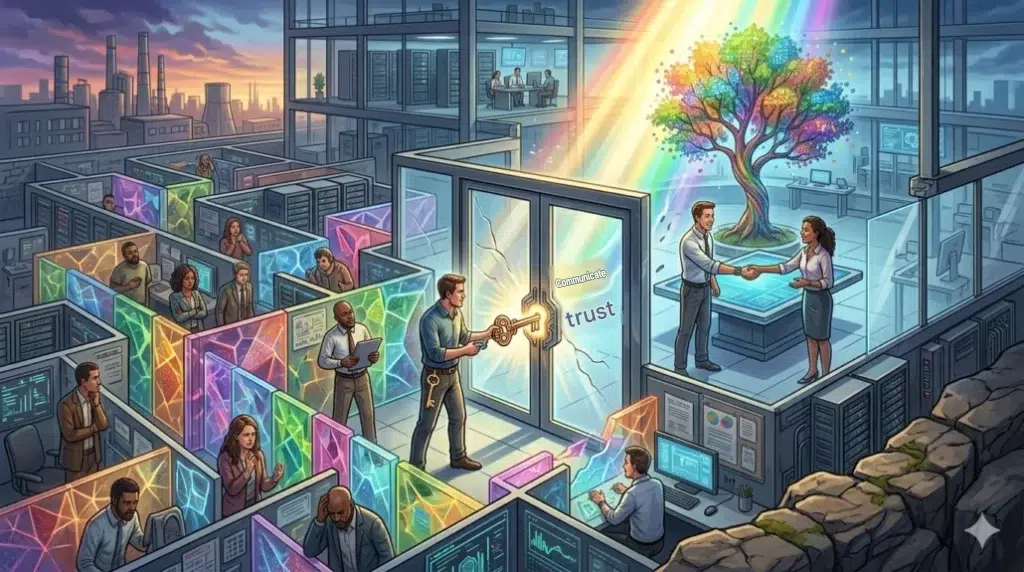
IV. Human-Machine Collaboration: AI as the Coach’s “Super Amplifier,” Not a Replacement
AI will not replace Scrum Masters and leaders; it will only replace those low-value coaches who merely perform administrative tasks and process execution. The true core value will be infinitely amplified under the empowerment of AI.
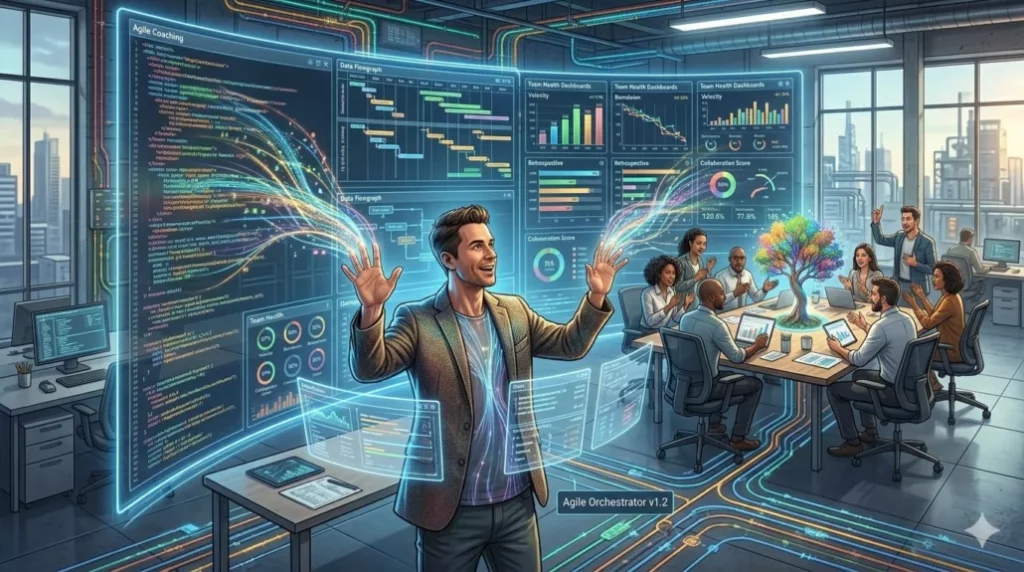
AI handles repetitive tasks, freeing up the coach’s energy. Transactional duties like meeting minutes, progress tracking, data statistics, risk warnings, and report generation can be efficiently completed by AI. This liberates coaches from tedious chores, allowing them to focus on high-value tasks such as coaching, communication, and culture building. The AI Era has brought shocks to teams, making it even more crucial for team leaders and coaches to help their teams embrace AI-driven workstyles, manage anxiety, and continuously improve amidst the transformation.
AI provides data insights, elevating decision-making quality. AI can analyze team collaboration patterns, identify process bottlenecks, and predict delivery risks, providing objective data support for the coach. This shifts coaching from being purely “experience-driven” to “data- and experience-driven.” For example, if AI discovers a team collaboration blind spot through communication data, the coach can provide targeted guidance for improvement. Human-machine collaboration makes team enhancements much more precise.
AI expands service boundaries, boosting competitiveness. Future Scrum Masters will leverage AI to serve multiple teams simultaneously, upgrading from a single-team coach to an organizational Agile expert. With AI providing scalable basic support and human coaches focusing on deep value creation, a collaborative paradigm emerges: “AI handles the breadth, humans handle the depth.”
Industry surveys indicate that Agile coaches adept at using AI see a 45% annual increase in market value, while the value of those relying solely on administrative tasks continues to decline. This proves that AI is not a substitute, but a powerful amplifier of core competitiveness.
V. Organizational Value: The More Powerful AI Becomes, the Scarcer Human Leadership Will Be
The core competitiveness in the AI industry lies in innovation and talent, and innovation stems from human creativity, collaboration, and intrinsic motivation. As technology grows increasingly intelligent, an organization’s need to “activate people” will only intensify.
On one hand, AI R&D teams heavily rely on creativity and collaboration. They need coaching leaders to protect the innovative atmosphere, stimulate team vitality, resolve technical disagreements, and balance efficiency with exploration. On the other hand, given the rapid iteration and high uncertainty of AI technology, teams require psychological safety and directional guidance more than ever to continuously break through.
Leaders and Scrum Masters are the “human hubs” of an organization, responsible for bridging technology and humanity, efficiency and warmth, the individual and the organization. In an era where AI comprehensively takes over efficiency-driven tasks, these human-centric roles become the key for organizations to maintain vitality, resist risks, and sustain innovation. The more technology-driven an industry is, the more it needs the balance of humanity; the more ubiquitous AI becomes, the scarcer leaders who can activate human potential will be.
VI. Capability Upgrading: From Process Executors to Strategic Coaches, Building Long-Term Competitiveness
Facing the AI Era, leaders and Scrum Masters need not be anxious. Instead, they should proactively upgrade their capabilities to build irreplaceable competitive barriers.
First, upgrade from a process administrator to a strategic coach. Abandon transactional work and focus on high-value endeavors such as team growth, organizational change, culture building, and strategy execution, becoming the team’s “growth partner” and the organization’s “catalyst for change.”
Second, become an AI super-user. Master AI tools, use data to empower coaching, utilize automation to boost efficiency, and apply intelligent analysis to optimize decision-making. Let AI be your “digital deputy” to achieve a dimensional upgrade in your capabilities.
Third, deepen your expertise in human nature and organizational capabilities. Continuously enhance empathy, communication skills, conflict resolution abilities, cultural shaping capabilities, and gray-area decision-making. These skills, impossible for AI to replicate, will form the core of long-term competitiveness.
Fourth, embrace an organizational perspective. Transition from serving a single team to driving organizational Agile transformations, designing human-machine collaboration mechanisms, and building talent development systems, ultimately becoming an organizational-level value creator.
Conclusion: In the AI Era, the Rarest Commodity is “Human” Leadership
Artificial intelligence is reshaping all industries, but it cannot replace the warmth of humanity, the power of trust, the brilliance of leadership, or the value of a coach. Human-centric roles like Team Leaders and Scrum Masters are not the cast-offs of the AI Era; they are its trailblazers.
AI handles efficiency and tools, while humans handle hearts and directions; AI takes charge of execution and optimization, while humans take charge of decision-making and accountability; AI manages processes and data, while humans manage culture and mission. As technology grows ever smarter, coaching leaders who can activate, unite, and elevate people will become the most competitive and irreplaceable core assets in the AI industry.
The future does not belong to those replaced by AI, but to those who skillfully utilize AI, deeply cultivate human connection, and uphold the true essence of leadership. For every team coach and leader, AI is not a threat, but a new starting point leading to higher value and stronger competitiveness.
Author: Eric Liao, Founder, Chief Consultant, and Coach of ScrumChina