
You open the AI, type your question, and get an answer in three seconds. While this efficiency is remarkable, overreliance on AI is creating a hidden crisis. You hit “copy,” paste it into your document, and close the tab.
Now here’s the question no one is asking: when was the last time you actually thought something through yourself?
Not skimmed an AI summary. Not accepted the first reasonable-sounding output. But genuinely wrestled with a problem — sat with the discomfort of not knowing, turned it over, and arrived at your own hard-won conclusion.
For many of us, that moment is getting harder to remember. And that’s the problem.
The Comfort Trap of AI Reliance
AI doesn’t feel dangerous. That’s precisely why it is.
Every time you hand a cognitive task to an AI tool, your brain experiences something close to relief. The mental load disappears. The effort evaporates. And your brain, being the efficiency-obsessed organ it is, logs this as a reward — and quietly files away a new rule: next time, just ask the machine.
A landmark mixed-methods study of 666 participants found that heavy AI tool use was associated with decreased critical thinking ability, mediated by cognitive offloading — the progressive delegation of mental effort to external tools. The study identified what the researcher termed “cognitive laziness”: a decline in the inclination to engage in deep, reflective thinking as a direct consequence of persistent AI reliance.
This isn’t a fringe concern. By delegating more and more intellectual tasks to machines — analyzing data, summarizing texts, proposing solutions — humans risk exercising these faculties less themselves. This transfer of mental load to AI can bring increased comfort and efficiency, but recent research suggests it is also accompanied by a measurable decline in certain thinking skills.
The reward loop keeps spinning. And each rotation makes the next delegation feel more natural.
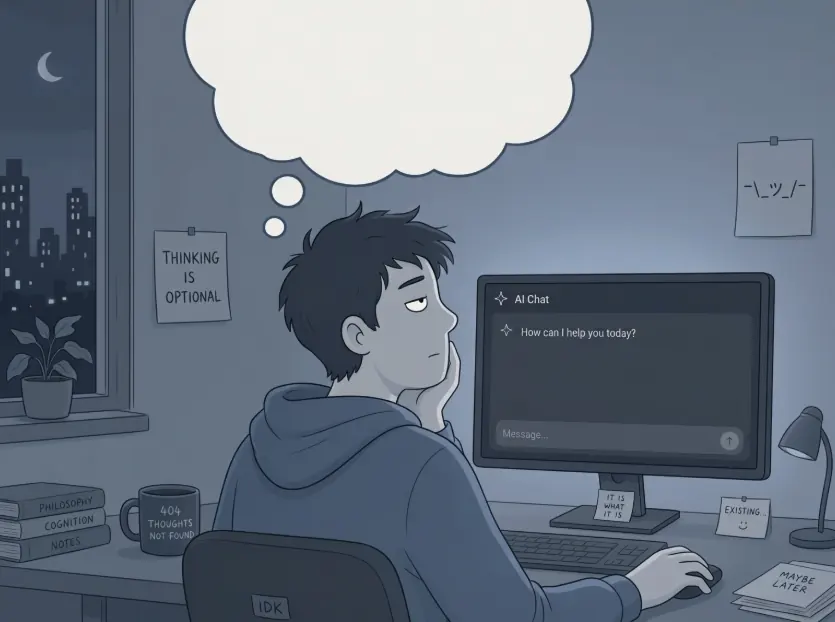
What Research Shows About Overreliance on AI
The evidence is no longer anecdotal. It’s piling up in peer-reviewed journals.
A study conducted by MIT’s Media Lab — Your Brain on ChatGPT — divided 54 subjects into three groups, asking them to write SAT essays using ChatGPT, Google Search, or nothing at all. Researchers used EEG to record brain activity across 32 regions and found that of the three groups, generative AI users had the lowest brain engagement and consistently underperformed at neural, linguistic, and behavioral levels.
Think about that for a moment. Not just worse essays — lower brain engagement.
“The struggle of writing wasn’t just outsourced; it was skipped. And without the struggle, the brain had nothing to encode.”
University students who used large language models to complete writing and research tasks experienced reduced cognitive load but demonstrated poorer reasoning and argumentation skills compared to those using traditional search methods. Another study found that students using LLMs focused on a narrower set of ideas, resulting in more biased and superficial analyses.
Meanwhile, the numbers from the workplace tell a parallel story. According to ActivTrak’s 2026 State of the Workplace report (analyzing 443 million hours of digital workplace activity across 163,638 employees), the landscape of human focus is rapidly shifting:
- AI adoption has skyrocketed: 80% of employees now use AI tools at work (up 52% from two years ago), with average time spent in AI tools increasing eightfold.
- Focus is shattering: Focus efficiency dropped to 60% — a three-year low.
- Deep work is shrinking: Average focused work sessions declined 9%, dropping from 14 minutes and 23 seconds to just over 13 minutes.
This overreliance on AI correlates with less focus. The correlation is uncomfortable — and impossible to ignore.
The Most Dangerous Part: You Can’t Feel It Happening
Here’s what makes this genuinely alarming: the erosion is invisible.
You still feel capable. Your outputs look polished. Your response times are faster than ever. But underneath the surface, something is quietly atrophying.
Researchers from Carnegie Mellon University and the University of Oxford found a disturbing trend: “People do not merely become worse at tasks, but they also stop trying.” The ease of use associated with generative AI creates a feedback loop in which increased use leads to higher trust, which results in more offloading and a subsequent decline in critical evaluation.
Once a user receives a well-reasoned, professional-sounding answer from an AI, it becomes difficult to think outside of that framework. Researchers at the University of Pennsylvania describe this as “cognitive surrender” — a phenomenon where people trust AI over their own intuition, even when the AI provides incorrect information.
Behavioral and decision-making research further shows that overreliance on authoritative AI advice suppresses reflective evaluation and miscalibrates confidence, particularly under time pressure or in complex situations — leading to deskilled judgment and diminished autonomy. Users tend to place excessive trust in AI-generated solutions and adhere to them even when errors are present.
The problem with overreliance on AI isn’t that you’ve made a conscious choice to stop thinking. It’s that AI makes not thinking so frictionless that it slowly becomes your default.
You don’t notice the muscle wasting until the moment you actually need to lift something heavy — alone, without the machine.
The Scaffold vs. The Substitute
This is not an anti-AI argument. Let’s be precise about that.
The polarity of the effect of AI use seems to depend on the nature of the reliance: whether AI is used appropriately and ethically. The same tool that hollows out one person’s judgment can sharpen another’s — the difference lies entirely in how they use it.
Think of it as the difference between a scaffold and a substitute.
A scaffold helps you build something taller than you could reach alone — but you’re still the one doing the building. You’re directing, evaluating, questioning. You use the AI output as a first draft, not a final answer. You bring your own judgment to bear on what the machine produces.
A substitute takes the job entirely. You hand over the problem, accept the output, and move on. The scaffold builds your capability. The substitute silently replaces it.
Let’s look at what this means in practice:
- The Substitute approach: You type, “Write an analysis report on why Q3 sales dropped.” You copy the output, paste it into a document, and send it to your boss.
- The Scaffold approach: You sit down and outline three of your own hypotheses for the sales drop. Then you prompt the AI: “Here are my three hypotheses for the Q3 sales drop. Based on these, point out any data blind spots I might have missed, and play devil’s advocate to argue against my conclusions.”
The first approach makes you dull. The second makes you sharper.
An overreliance on AI for problem-solving or content generation can lead to a passive learning approach, which is counterproductive to developing active, critical learning skills. The question to ask yourself — honestly — isn’t “am I using AI?” It’s “am I thinking alongside it, or am I just outsourcing to it?”
The AI-Native Professional: A Different Way to Engage
There’s a growing recognition that the most valuable professionals in the AI era won’t simply be those with the most AI tools — they’ll be those who can use AI without losing themselves in it.
Those who are thriving right now are adopting what is becoming known as an “AI-Native Professional” mindset. As highlighted by frameworks like the AI-Native Professional Model from APD Institute, the real challenge today isn’t access to AI — most professionals already have that. The actual challenge is whether they can use AI responsibly, redesign their workflows intelligently, manage the associated risks, and generate measurable value rather than just faster outputs.
AI fluency without cognitive discipline isn’t a skill. It’s a liability.
The AI-native professional isn’t someone who lets AI do their thinking. It’s someone who has trained themselves to think better because of how they engage with AI — someone who uses it as a thinking partner, not a thinking replacement.
What You Can Do Starting Today
If any of this lands uncomfortably close to home, here’s where to start:
Ask yourself first, before you ask the AI. Even 60 seconds of independent reasoning before opening a chatbot changes the dynamic entirely. You’re no longer a passive recipient of answers — you’re an evaluator of them. That shift matters more than it sounds.
Treat AI output as a first draft, never a final answer. What did it miss? What assumption is it making that you’d push back on? Where does your judgment diverge from its conclusion? These questions are where your actual thinking happens.
Rebuild the struggle, deliberately. Just as you can’t get stronger without resistance, you can’t maintain cognitive sharpness without practice. Regularly tackle problems — writing, analysis, decision-making — without reaching for the AI first. Think of it as mental training, not inefficiency.
Measure your engagement, not just your output. The question isn’t “did the work get done?” It’s “did I do any thinking?” A polished output that required zero judgment from you is not a win — it’s a warning sign.
Critical thinking — characterized by the evaluation of information, questioning of assumptions, and formation of independent judgments — remains a uniquely human skill that AI cannot fully replicate. The goal isn’t to outrun AI. It’s to remain the one who decides where it runs.
The Skill You Can’t Recover with a Prompt
AI’s memory is effectively infinite. It will never forget a formula, lose a reference, or blank under pressure.
Yours is not infinite. But you have something the machine will never have: judgment forged through genuine struggle — the kind that only comes from having actually wrestled with a problem, been wrong about it, and figured out why.
That judgment is built through use. And it erodes through disuse.
The irony of the AI era is that avoiding overreliance on AI will be your greatest advantage. The people who will matter most aren’t those who used AI the most — they’re those who never let it think for them entirely. They stayed in the loop, kept their edge sharp, and used the machine as a lever rather than a crutch.
The question worth sitting with — without asking an AI — is this:
What kind of thinker do you want to be five years from now? And is the way you’re using AI today building toward that, or quietly dismantling it?