
How AI High Performers Turn Time Into Money — While Everyone Else Just Gets Busier
Two colleagues striving to become AI high performers. Same company. Same job title. Same AI tools, deployed the same week.
One year later, Colleague A’s income is unchanged. She feels productive — her inbox is cleaner, her reports come out faster — but her bonus is the same, her client roster hasn’t grown, and she honestly couldn’t tell you where those saved hours went.
Colleague B took on a second retainer client in month three. By month eight, he was running internal AI workshops as a paid consultant on the side. His effective hourly rate has climbed 35% in twelve months.
Same tools. Same time saved. Radically different outcomes.
This is not a story about who works harder. It’s a story about one decision that separates the two. And once you see it, you can’t unsee it.
The Illusion of Productivity
Here’s the number that should unsettle everyone rolling out AI tools: 80% of respondents in McKinsey’s 2026 State of AI survey report that AI has improved their individual productivity — yet enterprise AI ROI remains out of reach for 94% of companies despite record spending, and while 80% of individual workers report productivity gains, only 6% of organizations attribute significant earnings impact to AI.
Read that again. Four out of five people feel more productive. Fewer than one in seventeen businesses can show it in their earnings.
The gap between “feeling productive” and “generating more revenue” is exactly where most AI adopters live — comfortable, busy, and financially stagnant.
What’s swallowing the time savings? Two culprits stand out.
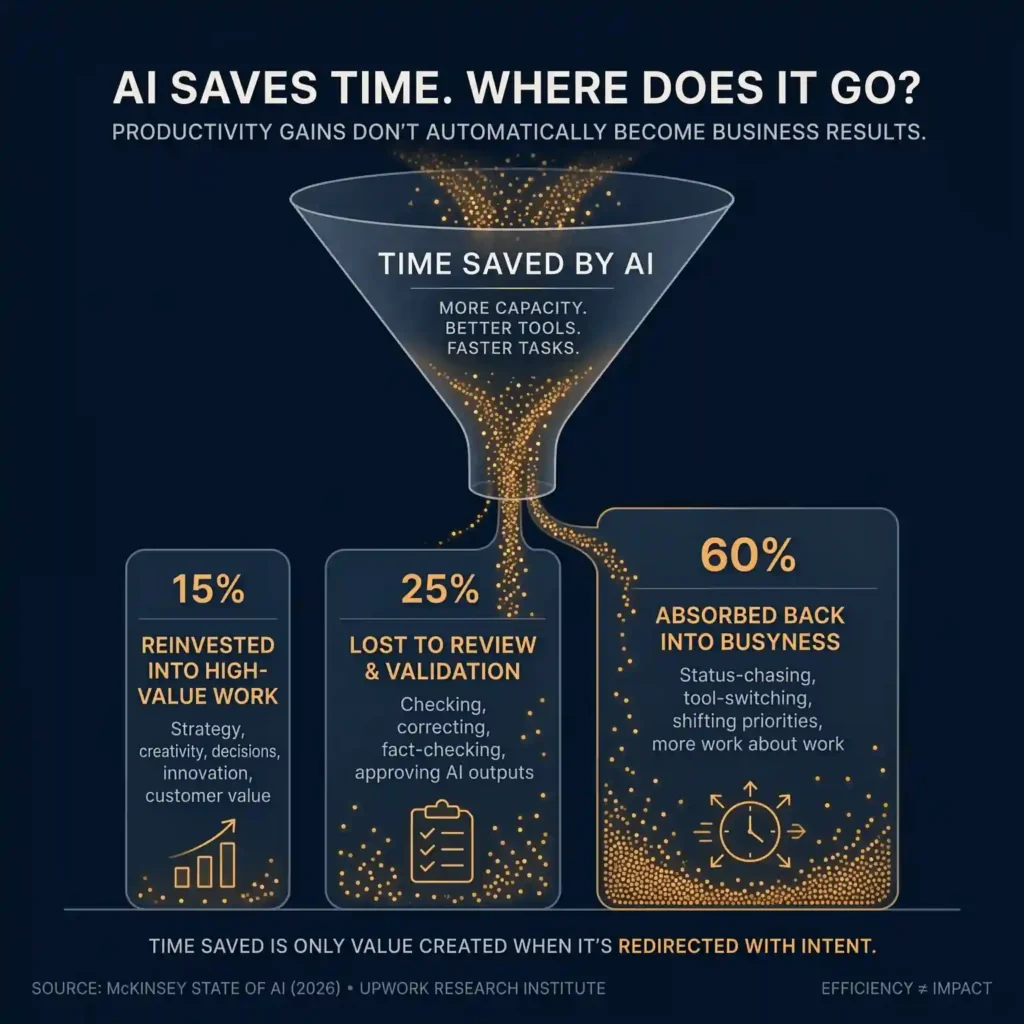
First, the hours simply evaporate into lower-quality work at higher volume. 77% of freelance workers using generative AI reported that it added to their workload rather than reducing it, primarily due to review and validation overhead, according to the Upwork Research Institute. The tool saves you an hour writing; you spend ninety minutes fact-checking what it wrote.
Second, most people save time in tasks without redesigning what they do with it. Knowledge workers spend roughly 60% of their time on “work about work” — status-chasing, tool-switching, and shifting priorities — rather than the skilled tasks they were hired to do. AI shaves time off the edges of that 60%. But the 60% remains.
Who Are the 6% of AI High Performers?
McKinsey surveyed 1,719 professionals and business leaders from around the world and across industries for its State of AI 2026 report, and found that more businesses are deploying more AI in the belief that their investments will start paying off, but the number of people reporting an actual earnings boost from their AI initiatives has remained flat.
The small group beating this trend has a name: AI high performers. Respondents who attribute EBIT impact of 5% or more to AI use and say their organization has seen “significant” value from AI use — McKinsey’s definition of AI high performers — represent about 6% of respondents.
The picture is nearly identical at the individual and market level. Just 20% of companies are capturing 74% of all AI-driven value, according to PwC’s 2026 Global AI Jobs Barometer. There is a pronounced ‘super-star’ effect; the top fifth of most-exposed companies achieve stellar 163% productivity growth on average.
This is not a bell curve. It’s a spike. Most organizations cluster near zero real earnings impact, while a small group captures an outsized share of the value AI creates.
What makes these organizations — and the individuals inside them — different?
It comes down to three decisions.
Decision 1: They Treat Saved Hours as Capital, Not Rest
Generative AI users save an average of 5.4% of their work hours — about 2.2 hours in a 40-hour week — with a third of daily users saving 4+ hours weekly. That’s the Federal Reserve Bank of St. Louis’s figure, and it’s probably conservative for power users.
Employees who use AI tools may save nearly the equivalent of a full working day per week — around 7.5 hours on average, according to research from the London School of Economics’ Inclusion Initiative and Protiviti. Training can double productivity and hours at work saved, upward of 11 hours per week.
Most people treat those recovered hours as a pressure valve — a chance to breathe, to clear the backlog, to feel less behind. That’s human and understandable. Make no mistake: using saved time to step away from the screen, catch your breath, or spend time with family is genuinely valuable for your well-being. But if you are frustrated by a stagnant income, a career plateau, or a lack of leverage, treating those recovered hours solely as a rest stop is exactly the reason your trajectory doesn’t move.
AI high performers treat those hours as investment capital.
The freelance content strategist who reclaims eight hours a week doesn’t use them to watch TV on Thursday afternoon. She uses them to pitch two new clients she didn’t have bandwidth for before. The mid-level product manager who saves six hours a week on reporting doesn’t fill those hours with more reporting. He uses them to lead an internal AI task force — which becomes a visible, promotable achievement.
The math is simple and the behavior is rare. Saved hours only become earned income when they’re deliberately pointed at something that generates income.
Decision 2: They Redesign Workflows, Not Just Tasks
This is the finding that McKinsey buries in Exhibit 9 but that explains most of the performance gap.
Nearly three-quarters of AI high performers said they had fundamentally redesigned workflows because of AI, versus one-quarter of other respondents. They were 3.3 times as likely to intend to use AI to fundamentally transform the business within three years.
Think about what that means in practice. The average knowledge worker uses AI to write faster, summarize faster, search faster. They’re automating individual tasks inside a workflow that was designed for a pre-AI world. The result: marginal gains.
AI high performers ask a different question. Not “how do I use AI to do this task faster?” but “if AI exists, does this task need to exist at all — and what should the workflow look like from scratch?”
Let’s look at a concrete example: weekly status reporting. The average user (Tier 1) prompts ChatGPT to summarize their meeting notes into an email, turning a 60-minute task into a 20-minute task. They saved 40 minutes. The AI high performer asks a fundamentally different question. They use AI to write a simple script that connects their project management tool directly to a dashboard, automating the data extraction and formatting completely. They didn’t just save 40 minutes; they eliminated the manual reporting task entirely and created a scalable system that updates in real-time.
The data from 758 BCG consultants studied by Harvard Business School illustrates what’s possible when that question gets asked properly. BCG consultants with access to GPT-4 completed 12.2% more tasks, worked 25.1% faster, and produced results rated 40.2% higher in quality than the control group on tasks within AI’s capability frontier.
But here’s what’s often missed in that headline: the consultants who captured the biggest gains weren’t just using AI on isolated slides. They were restructuring how they moved from research to insight to deliverable — the whole pipeline, not individual steps.
The variable that separates the 6% is not a model or a budget. High performers are nearly three times as likely to have fundamentally redesigned their workflows around AI. This is precisely the gap that structured frameworks address — the move from “I use AI tools” to “I think in AI-native systems.”
If you want to see exactly what this looks like across different roles, we created the free AI-Native Professional Competency Model. It’s not a list of tool tutorials; it’s a structured framework showing exactly what strategic judgment and workflow redesign look like in practice.
Decision 3: They Monetize the Skill Gap Itself
This is where individual high performers diverge most visibly from the average user — and where the earnings gap becomes genuinely stark.
Jobs requiring specific AI skills are growing almost eight times (69%) faster than the total jobs market (9%), with the average wage premium for AI skills rising to 62%. That’s PwC’s 2026 Global AI Jobs Barometer, analyzing over one billion job advertisements across 27 countries.
The report’s larger argument is that AI is splitting the labor market into two tracks: one where AI mostly automates routine work, and a faster-growing one where it amplifies human judgment and pays a steep premium for the people who can wield it.
Jobs “professionalised” by AI are growing twice as fast as jobs “democratised” by AI, with 42% faster wage growth since 2021. And roles where AI removes routine tasks and enables workers to focus on higher-value activities — such as judgment and decision-making — are seeing stronger growth (39%), compared to 17% growth in roles where AI is primarily simplifying tasks.
In other words: using AI to go faster on what you already did puts you in the slower-growing, lower-wage track. Using AI to upgrade what you do puts you in the other one.
AI high performers operate at three tiers:
- Tier 1 — User: You use AI tools to deliver existing services faster. You keep the time savings as margin but charge the same rates. Income effect: moderate efficiency gain, no earnings growth.
- Tier 2 — Builder: You use AI to create new offerings — AI-powered products, automated client deliverables, templated systems others pay to access. Income effect: new revenue streams, often with better margins.
- Tier 3 — Advisor: You consult, train, and lead on AI implementation for organizations still figuring it out. Your AI proficiency is itself the product. Income effect: significant hourly rate premium, often 40–60% above your pre-AI baseline.
PwC found the AI wage premium ranges from as high as 118% in consumer-markets roles down to about 16% in government and public-sector work. The premium is real — but it accrues almost entirely to Tiers 2 and 3.
Most professionals stay at Tier 1. Not because they lack capability, but because they’ve never been shown what Tier 2 looks like for their specific role.
The Mindset Fault Line
There’s a finding buried in the BCG study that almost nobody talks about.
GPT-4 acts as a “great equalizer” among elite consultants. BCG’s lowest-performing consultants improved 43% when using AI, while top performers gained only 17%.
The standard read on this is “AI levels the playing field.” And at the task level, it does.
But here’s the strategic reality: top performers still earn more, advance faster, and capture a disproportionate share of the value. Why? Because they direct their 17% gain toward harder, higher-value, higher-visibility work — problems only they can solve. The junior consultant who gained 43% used it to do more of the same, faster.
The losing mindset: “AI saved me 3 hours today, so I can finish early.”
The winning mindset: “AI saved me 3 hours today. I now have 3 hours to do the thing I’ve been saying I don’t have time for.”
80% of respondents say their companies set efficiency as an objective of their AI initiatives, but the companies seeing the most value from AI often set growth or innovation as additional objectives. Efficiency is a floor, not a ceiling. High performers use it as a launchpad.
In Microsoft’s 2026 Work Trend Index, a survey of 20,000 knowledge workers who use AI at work, 66% say AI has allowed them to spend more time on high-value work and 58% say they’re producing work they couldn’t have produced a year ago. That 58% figure is worth pausing on. It’s not just doing more. It’s doing things that were previously out of reach.
That expansion of capability — not the time saved — is where the earnings move.
Three Questions to Audit Yourself Right Now
The data draws a clear line between those who save time and those who convert time into income. Before you read on, answer these honestly:
1. Are your saved hours documented and deliberately reallocated? If you can’t name what you did with last Tuesday’s AI-recovered two hours, you didn’t invest them — they dissolved.
2. Has your workflow changed, or just your tools? If your overall process looks the same as it did 12 months ago with AI bolted on at individual steps, you’re likely in the 94%, not the 6%.
3. Is your AI proficiency visible and marketable to others? Can you articulate, in a job interview, a client pitch, or a performance review, how your AI approach produced a specific, measurable result? If not, you’re at Tier 1.
Skills needed for the most AI-exposed jobs are changing more than twice as fast as for the least AI-exposed jobs. The half-life of “I know how to use ChatGPT” as a differentiator is already expiring. What’s replacing it is demonstrated judgment — knowing when, how, and why to deploy AI in ways that drive outcomes.
If you’re ready to build that demonstrated judgment systematically, we highly recommend exploring the free AI-Native Professional Competency Model from APD Institute. It offers a structured guide for practitioners who want to map out the exact capabilities required to move from Tier 1 to Tier 3 and stay ahead of the curve.
The Real Question
McKinsey’s central tension is not “AI doesn’t work.” It is “AI works in the inbox before it works in the earnings call.”
That’s the cleanest summary of this entire discussion. The individual productivity gains are real. The earnings impact — for most people — is not yet.
The gap between those two facts is not closed by better prompts or faster models. It’s closed by a decision: to treat the time AI returns to you as the most valuable resource you have, and to point it — deliberately, consistently, without wasting it on busyness — at something that generates income, builds capability, or creates something new.
The companies achieving the biggest productivity gains from AI are not using it only to cut costs. They’re using it to grow. The same is true for individuals.
Six hours a week is 312 hours a year. That’s the equivalent of nearly eight full work weeks. Compounded across a career, it’s the difference between the person who survived the AI transition and the person who was built by it.
The question isn’t how much time AI is saving you. It’s what you’re doing with the time AI saves you.
If your honest answer is “I’m not sure” — that’s where to start.
If AI handed you back every Friday afternoon for the next six months, what would you build, launch, or learn? Drop your answer below — genuinely curious whether people’s instinct is “rest” or “reinvest.”