
AI does not repair a broken operating model. It accelerates it. Leaders who choose platforms before redesigning work risk scaling friction, embedding waste, and mistaking adoption for transformation.
The Most Expensive AI Mistake Happens Before Procurement
A familiar enterprise AI rollout begins in a conference room.
A vendor gives a dazzling demonstration. The model drafts proposals, summarizes meetings, analyzes contracts, and answers questions in seconds. Executives see momentum. Procurement negotiates licenses. Thousands of employees receive access.
Then reality arrives.
Marketing produces content faster, but legal review becomes a larger bottleneck. Sales generates account briefs instantly, but representatives still copy the results into three systems. AI flags supply risks, but procurement cannot act until multiple teams reconcile their data. Managers save time writing reports—and spend it reviewing a rising volume of machine-generated work.
The technology worked. The workflow did not.
PwC’s 2026 research captures the gap: only one in eight CEOs is seeing both increased revenue and reduced costs from AI.
That result should unsettle any leadership team still treating AI transformation as a technology acquisition programme.
A tool can accelerate a task. Only a redesigned workflow can remove the queue, the handoff, and the decision latency.
Adoption Is Rising. Enterprise Value Is Not.
Enterprise AI has no shortage of activity. It has a shortage of converted value.
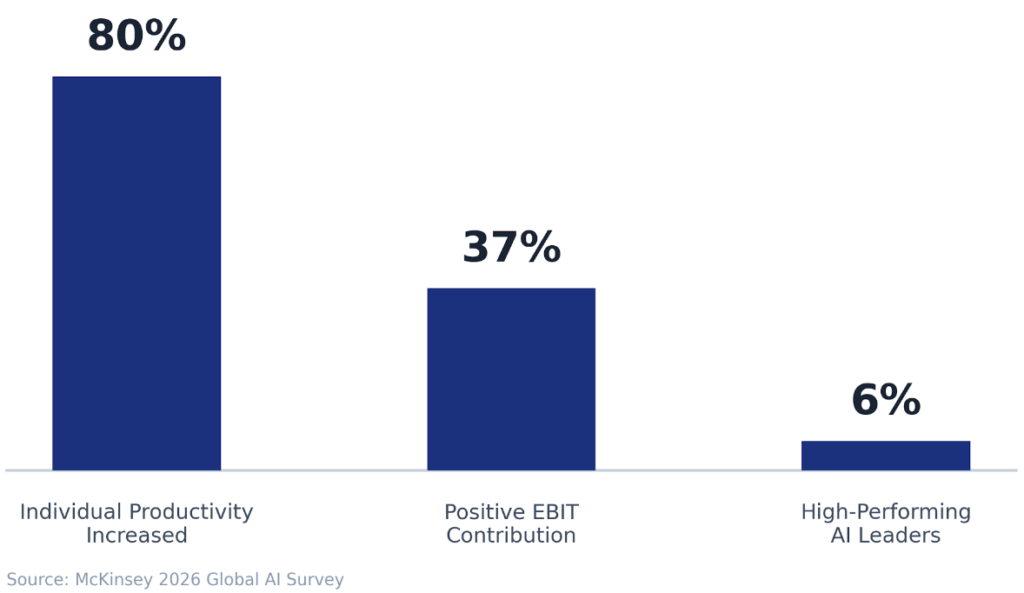
According to McKinsey’s 2026 global AI survey, eight in ten respondents say AI has improved their individual productivity. Yet only 37% report a positive contribution to enterprise EBIT, essentially unchanged from the previous year. Organizations classified as AI high performers account for just 6% of respondents.
The apparent contradiction disappears when we distinguish task productivity from workflow productivity.
Imagine that AI reduces the time required to prepare a customer proposal from four hours to twenty minutes. That sounds transformative. But if pricing approval still takes two days, customer data remains fragmented, and non-standard terms trigger a week of email exchanges, the customer experiences almost no improvement.
The drafting task became faster. The commercial workflow did not.
Enterprise performance is not the sum of isolated time savings. Time saved in one step matters only when it becomes shorter cycle time, lower operating cost, greater capacity, better quality, reduced risk, or additional revenue across the complete flow of work.
The workflow—not the prompt, model, agent, or license—is the unit through which enterprise value is created.
Strongly recommended visual — Evidence chart: Three descending bars showing 80% reporting individual productivity gains, 37% reporting positive EBIT contribution, and 6% qualifying as AI high performers. Use a clean white-paper layout, generous whitespace, and one accent color. Cite McKinsey directly beneath the chart.
A Faster Bad Workflow Is Still a Bad Workflow
Most enterprise workflows were not designed. They accumulated.
A control was introduced after an incident. An approval was added during a reorganization. A spreadsheet bridged two incompatible systems. A meeting compensated for unclear ownership. Over time, temporary fixes became permanent operating logic.
Placing AI on top of that logic can make the organization busier without making it better.
Deloitte’s 2026 research on enterprise AI transformation found that 48% of respondents had introduced AI without redesigning the workflows or roles around it. Only 12% reported redesign at scale backed by a new operating model.
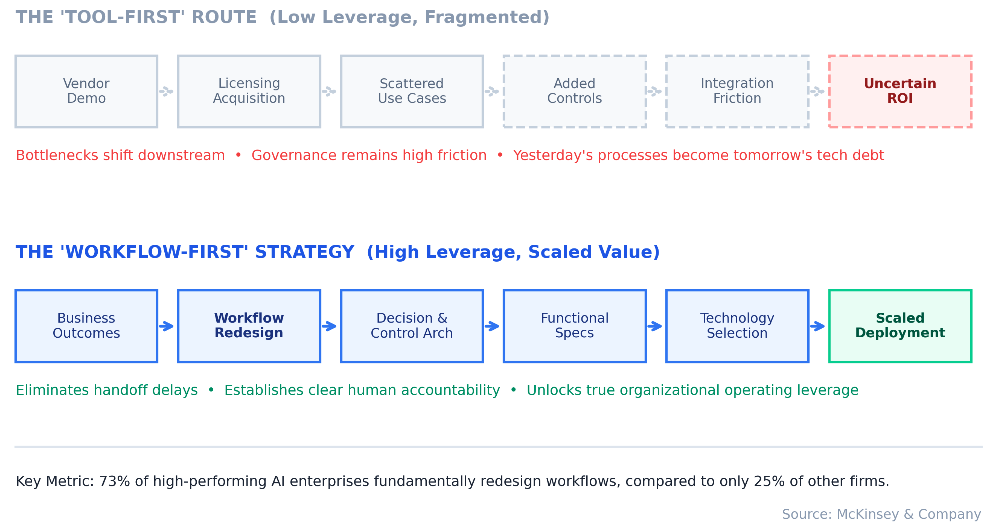
The tool-first approach fails in predictable ways.
It relocates bottlenecks. When AI multiplies output upstream, overloaded reviewers, decision-makers, or systems downstream receive more work.
It preserves obsolete decision rights. AI may produce an answer in seconds, but the organization still requires the same people to discuss, approve, restate, and transmit it.
It turns governance into additional friction. Because autonomy and accountability were not designed into the workflow, leaders respond by adding human checks at every stage. The organization acquires machine speed and then surrounds it with manual brakes.
It also encourages the wrong metrics. License activation, prompt volume, pilot counts, and hours “saved” become proxies for progress, even when customer outcomes and financial performance remain unchanged.
When procurement comes first, the chosen platform exerts a quiet gravitational pull. Teams begin defining opportunities according to what the product can demonstrate. The vendor’s feature set becomes the organization’s transformation strategy.
When technology is selected first, yesterday’s process becomes tomorrow’s technical debt.
Workflow Redesign Is the Real Requirements Process
Workflow redesign does not mean documenting every existing process for a year. Nor does it mean making technology wait until the organization has reached some imaginary state of perfection.
It means answering a set of business questions before answering a software question:
- What measurable outcome should this workflow produce?
- Which steps exist because they create value, and which exist because of historical constraints?
- Which decisions require human judgment, and which can be delegated within defined limits?
- What data and organizational knowledge are required at each point?
- What happens when information is incomplete, the model is uncertain, or the situation falls outside policy?
- Who remains accountable for the outcome?
- Which measure—cycle time, conversion, cost, quality, risk, or capacity—will prove that the workflow has improved?
These answers become the real technology requirements.
They reveal whether the organization needs a copilot assisting an employee, an agent completing a bounded process, several agents coordinating across functions, a model embedded in an existing product, or simply better data and fewer approvals.
They also prevent a common category error: using AI where eliminating a step would create more value than automating it.
This is part of a broader shift from adopting AI tools to designing an AI-native enterprise. The APD Institute’s AI-Native Organization Capability Model explains how workflow redesign connects with strategy, talent, organizational knowledge, governance, leadership, and human–AI collaboration.
The Sequence That Turns AI Spend Into Operating Leverage
A workflow-first rollout follows a disciplined order.
Start with value
Choose a consequential business outcome, not a fashionable use case. Establish the current economics: cycle time, labor cost, error rate, rework, abandoned demand, lost revenue, customer impact, and risk exposure.
“Deploy an AI sales assistant” is a technology objective. “Reduce the time from qualified lead to approved proposal while increasing conversion” is a business objective.
Map the work as it actually happens
Follow a real case from beginning to end. Observe the spreadsheet bridges, inbox approvals, duplicate entries, informal workarounds, waiting periods, and difficult exceptions.
The official process map usually describes how work is supposed to move. Value leaks through the way it actually moves.
Design the target human–AI workflow
Eliminate unnecessary steps before automating the remaining ones. Decide where AI should retrieve information, generate options, recommend an action, execute a transaction, monitor outcomes, or escalate an exception.
Then make human responsibility explicit. A person should not be inserted merely to make the design feel safer. Human involvement should serve a defined purpose: judgment, empathy, authorization, accountability, or exception handling.
Specify capabilities and controls
Translate the target workflow into requirements for integration, context, permissions, orchestration, observability, audit trails, security, latency, reliability, model flexibility, and cost.
Governance should live inside this design. The workflow must define which actions are permitted, which are reversible, when confidence is insufficient, what evidence must be retained, and who can interrupt or override the system.
Select technology and test the complete flow
Now evaluate products against the workflow specification.
Do not test only the polished, high-frequency path. Test ambiguous input, incomplete data, policy conflicts, integration failures, adversarial behavior, and the cases that require escalation. An agent that succeeds in a demonstration but collapses at the first exception is not an enterprise system.
Measure the full workflow, not the isolated AI task.
Scale the operating pattern
After one workflow produces measurable results, reuse its knowledge assets, control patterns, integrations, governance mechanisms, and measurement discipline elsewhere.
Scale proven operating logic—not merely licenses.
The performance difference is already visible. McKinsey reports that nearly three-quarters of AI high performers fundamentally redesign workflows, compared with only one-quarter of other respondents.
Technology Selection Comes Last—But Not as an Afterthought
“Technology comes last” does not mean technology is unimportant. It means technology should be chosen against requirements rather than allowed to create them.
Once the target workflow is clear, selection becomes faster, more technical, and less political.
Can the platform operate across the full flow of work? Can it access the necessary context without creating uncontrolled exposure? Can autonomy vary according to the risk of the action? Can people inspect, interrupt, and override it? Can the organization replace models without rebuilding the workflow? Will the economics remain attractive at production volume rather than demonstration volume?
These questions are difficult to answer when the workflow is undefined. After redesign, they become a practical scorecard.
Nor does workflow-first require a slow, multi-year reengineering programme. A cross-functional team can focus on one valuable workflow, develop a target state, test its hardest assumptions, and refine it through disciplined experimentation. Speed matters. Sequence matters more.
The World Economic Forum reached a similar conclusion in its 2026 study drawing on insights from more than 450 executives: realizing AI’s full value requires organizations to rethink how work is performed, how decisions are made, and how operating models are designed. Its principles for adoption at scale include end-to-end operating-model redesign, human accountability, scalable talent systems, transparency-driven trust, and disciplined experimentation.
The lesson is not that enterprises should delay AI. It is that they should stop confusing haste in procurement with speed in transformation.
The Board Question That Changes the Conversation
Before approving the next AI platform, leaders should stop asking only, “Which tool should we buy?”
They should ask:
- Which business workflow will operate materially differently?
- Which decisions, handoffs, roles, and controls will change?
- Which economic outcome should improve—and how will we know?
If the leadership team cannot answer those questions, it is not ready to select technology. It is ready only to purchase possibility.
In 2026, access to capable AI is no longer scarce. Organizational coherence is.
When competitors can buy the same models, sustainable advantage comes from designing an organization in which those models can create value. The next AI winner will not be the company with the longest tool list. It will be the company that redesigns work before software quietly redesigns it for them.
So the question for every executive team is simple—and deliberately uncomfortable:
Have you redesigned a complete workflow around AI, or have you mainly added AI to the work people already do?