
Most organizations are still asking the wrong question about AI: can it do this? That question feels rigorous. It isn’t. Capability is the easy half of the problem, and it produces confident answers followed by expensive rework. The harder question about human-AI collaboration boundaries is smaller: what is the smallest unit of work a human must sign off on?
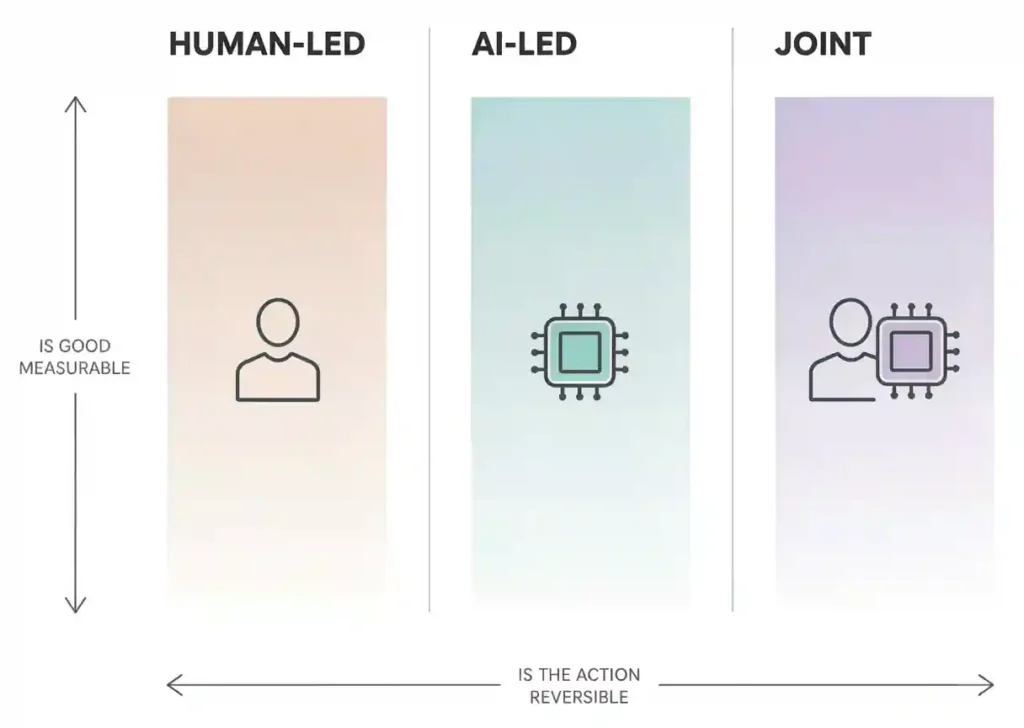
Answer that, and most of the line draws itself — not by job title or how much you care about the outcome, but by two unglamorous properties of the work. Can “good” be measured automatically? Can the action be undone?
Sort any task by those two variables and three zones fall out.
The Wrong Question: “Can AI Do This?”
Microsoft’s 2026 Work Trend Index traces how software engineering moved through four patterns in roughly four years: Author (AI suggests a line, the human writes), Editor (the human reviews a full draft), Director (the human writes a spec, the agent executes and tests itself), and Orchestrator (one person runs several agents against a shared backlog).
Two things changed at every step: what the agent could do, and what the human was responsible for. If you track only the first, your human-AI collaboration boundaries will be wrong within a year.
Microsoft’s conclusion matters more than the ladder itself. Where work belongs depends “less on importance and more on how clearly it’s defined.” That is the reframe. Importance is a feeling. Definition is a property you can inspect.
Zone 1 — Human-Led, AI-Supported
This is where “good” resists measurement and a wrong answer lands on a person, a relationship, or a liability. It is also where most human-AI collaboration boundaries get set by consequence rather than capability.
Dynatrace’s survey of 919 senior leaders found they expect a 50/50 human–AI split for IT operations and routine customer support, but 60/40 human-weighted for business applications. Same technology, different zone. Code Ninety’s study of 188 enterprise AI architects quantifies what drives the difference: an error tolerance of 0.01% in healthcare against 2.5% in e-commerce and marketing.
The failure mode here isn’t a bad AI answer. It’s a plausible one, delivered to someone who has quietly lost the ability to check it. Delegate the drafting, keep the judgment — and keep the skills that make judgment possible.
Zone 2 — AI-Led, Human-Authorized
When good is measurable and the action is bounded and reversible, the economics flip. AI leads; the human’s job shrinks to authorization and spot checks.
Few companies are close to trusting this. Only 13% of organizations run fully autonomous agents, 87% are building or deploying agents that require human supervision, and 69% of agentic decisions still get verified by a person. Where the human must approve every action before it takes effect — the dominant model at 58.5% — the share running full autonomy drops to 11.7% (Code Ninety).
The bottleneck isn’t capability. It’s authorization. As the World Economic Forum and Capgemini argue in their 2026 governance playbook, organizations can usually describe what an agent can do but not what it is authorized to do. Their fix: a per-deployment record of permitted actions, contexts, conditions, and the named human who owns the outcome.
That is where most human-AI collaboration boundaries in production actually sit today: at the authorization gate, not at the output. The distinction matters: reviewing every output is not oversight. At machine speed it is a queue, and a backed-up queue is one people stop reading. Dynatrace found 44% of organizations still review agent-to-agent communication flows by hand. In this zone, review the permission boundary and the escalation threshold, not the artifact. In most enterprise AI transformation programs, that gate is where the real design work sits.
Zone 3 — Where Human-AI Collaboration Boundaries Blur
The third zone is the one most teams skip, because it can’t be standardized. It is also where the value is.
In research and open-ended problem solving, neither side is reliable alone. A March 2026 study on neurosymbolic mathematical discovery documented the split cleanly: the AI agent excelled at uncovering hidden structure and generating hypotheses, symbolic solvers supplied rigorous verification, and human steering “supplied the critical research pivot that transformed a dead end into a productive inquiry.” The same paper found that multi-model deliberation was reliable for criticism and error detection, but unreliable for constructive claims.
That gives you a workable rule: let the models argue, let the human choose the destination. Nature’s May 2026 papers on Google DeepMind’s Co-Scientist and FutureHouse’s Robin point the same direction: multi-agent systems built so the scientist stays inside the decision loop.
How to Draw Your Own Human-AI Collaboration Boundaries
Four questions, asked per workflow rather than per department:
- What is the smallest unit a human must sign off on? If the answer is “everything,” you don’t have a boundary. You have a bottleneck with extra steps.
- Can the action be undone? Reversible actions can run wide. Irreversible ones need a gate, no matter how accurate the model looks today.
- Can “good” be measured automatically? If not, AI prepares and a person decides.
- Who owns the failure, by name? Unassigned accountability is how a pilot becomes an incident.
Then keep watching the line: human-AI collaboration boundaries do not stay where you put them. JumpCloud’s Q3 2026 IT trends report found that the share of organizations requiring human review before high-risk AI actions fell from 40% to 25% in six months, while full autonomy without review doubled, from 11% to 26%. Nobody announced that decision. It drifted, one convenient exception at a time.
Drawing these lines was never about slowing AI down. It is about making delegation accountable, so that when you hand work to a system you can still say who answered for it.
Making those calls at the organizational level is not a tooling decision. It is an operating-model decision: who decides, who funds, who is answerable, and how work is redesigned around humans, agents, and control points. APD Institute’s AI-Native Organization Capability Model treats exactly those questions — its accountability and workflow domains — as a capability to build rather than a policy to publish.