
Home / Competency Model
AI Professional Competency Model
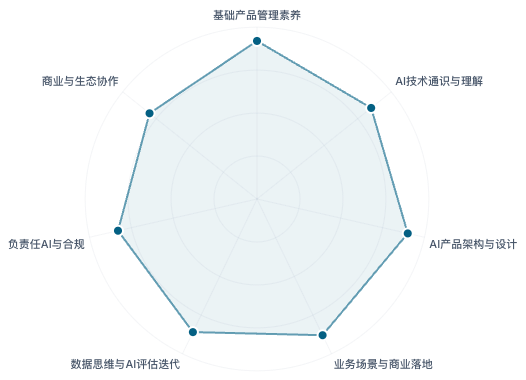
Competency Radar Overview
AI Product Manager
AIPM
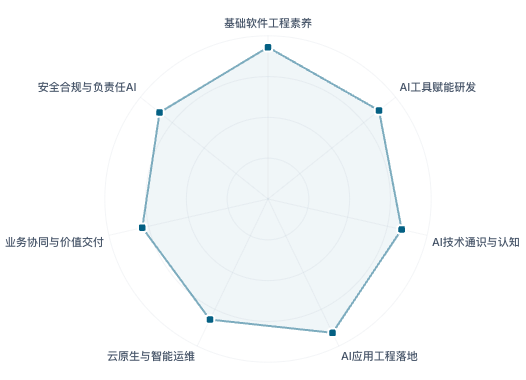
AI Engineer
AIE
In-Depth Competency Dimensions
Each dimension includes core definitions and key competency points that can be directly broken down into assessment criteria
This model is the seven-competency framework for AI Product Managers systematically defined by the Expert Committee of the AI Product Development Alliance (APD Alliance). It is built on core product management theory, informed by extensive industry practice in the AI field, and aligned with talent demands in the AI era, serving as a core component of APD Alliance standards. The model is structured around seven core dimensions—Foundational Product Management Literacy, AI Technical Literacy and Comprehension, AI Product Architecture and Design, Business Scenarios and Commercial Implementation, Data-Driven Thinking and AI Evaluation and Iteration, Responsible AI and Compliance, and Business and Ecosystem Collaboration—providing comprehensive coverage of competency requirements across the entire AI Product Manager career lifecycle.
Core Definition: The professional foundation of an AI Product Manager, serving as the bridge between traditional product capabilities and AI-specific expertise. It emphasizes “universal competencies + enterprise-grade collaboration,” adapting to all AI product development scenarios and AI-empowered product R&D contexts.
Core Product Capabilities
Product strategy and vision planning, roadmap development, requirements discovery and user research, PRD/flowchart/prototype design
Product Team Collaboration
Agile/Lean development (Agile/Scrum), iteration planning, cross-functional collaboration (product, engineering, algorithm, data teams), internal and external stakeholder management, advancing collaboration through a value-stream lens
Professional Acumen
Logical reasoning, structured problem decomposition, prioritization decision-making, documentation proficiency, user empathy, and business insight
End-to-End Value Stream Management
Full-lifecycle value stream management of AI products—from 0-to-1 initiation, iterative optimization, launch and operations, to sunset—focused on sustained long-term value delivery rather than phased handoffs
Core Definition: The key differentiator from traditional Product Managers. While deep algorithm R&D is not required, PMs must possess “technical translation capabilities,” understand AI technology boundaries and application logic, and align with industry-wide technical literacy frameworks.
Fundamental Concepts
Foundational knowledge of machine learning/deep learning, large language models (LLMs), generative AI, and core principles of multimodal technology
Core Technology Stack
RAG knowledge bases, Prompt Engineering, vector databases, and intelligent Agent workflows
Technology Boundaries
Recognizing and addressing model capability limitations, hallucination issues, response latency, and compute cost constraints
Tools and Platforms
Mainstream AI tools, foundational cloud service deployment, and AI development platform utilization
Core Definition: Designing implementable AI products from 0 to 1 based on AI technology characteristics, emphasizing “scenario-driven + executable” solutions aligned with real-world industry application needs.
Product Form Design
Decomposition and design of AI product forms including conversational, generative, decision-support, and intelligent Agent interfaces
Core Architecture Design
End-to-end architecture for generative AI products (input layer → intent recognition → execution engine → output layer → monitoring layer), knowledge base architecture, and retrieval logic design
Interaction and Experience Design
Prompt scripting and persona design, multi-turn dialogue logic, AI experience optimization, and fallback strategies
Implementation Adaptation
Designing implementable product solutions within technology boundaries, balancing experience and cost
Core Definition: The embodiment of an AI product’s core value, emphasizing “scenario decomposition + commercial value conversion,” aligned with real-world industry implementation logic to solve tangible enterprise problems.
Scenario Decomposition
Requirement decomposition for vertical industries (finance, manufacturing, education, government, etc.) and identification of AI empowerment opportunities
Solution Design
Industry scenario solution authoring, business process reengineering, benchmark case decomposition and reuse
Commercial Value
ROI modeling, cost control (compute, API, labor), commercialization design (pricing, billing models, packaging strategies)
Value Delivery
Customer success, product value realization, requirement responsiveness and value delivery follow-through, collaborating with product teams for sustained value output
Core Definition: The continuous optimization capability for AI products, integrating industry data-loop thinking with evaluation systems, emphasizing “data-driven + continuous iteration.”
Metric Framework
Building and monitoring core AI product metrics (hit rate, accuracy, recall, hallucination rate, user satisfaction)
Evaluation Methodology
Model performance evaluation, A/B testing, canary releases, and version iteration management
Data Analysis
Conversation log analysis, user behavior insights, data quality assessment and optimization
Continuous Optimization
Knowledge base iteration, Prompt optimization, product experience iteration, incident retrospectives and troubleshooting
Core Definition: The baseline capability for AI products, benchmarked against industry responsible AI principles and integrated with China’s AI regulatory requirements, treated as an independent core dimension.
AI Ethics
Fairness, transparency, explainability, and unbiased design to prevent model discrimination
Compliance Requirements
Data security, privacy protection (e.g., Personal Information Protection Law), algorithmic compliance, and industry regulatory requirements (e.g., Generative AI Service Compliance Guidelines)
Risk Management
Identification and mitigation of model, data, and security risks; establishing traceable, auditable, and intervenable mechanisms
Trustworthy AI
Designing verifiable and controllable AI products that safeguard user rights and enterprise compliance
Core Definition: The core capability for AI Product Managers advancing to senior roles, integrating industry ecosystem thinking with commercial operations logic, emphasizing “ecosystem synergy + long-term value.”
Commercial Operations
Product commercialization, channel partnerships, customer operations, and user growth
Ecosystem and Team Collaboration
Collaboration with product, algorithm, and data teams, cloud providers, industry partners, and open-source communities, integrating resources around value streams
Innovation and Trends
AI industry trend analysis, technology roadmap judgment, innovation opportunity identification, and open-source tool adoption
Industry Empowerment
Methodology codification, team mentoring, competency framework building, and participation in industry standards
Core Definition: The foundational professional base of an AI Engineer, underpinning all intelligent R&D work. It focuses on disciplined engineering thinking, solid technical proficiency, and high-quality coding capabilities—ensuring software systems are stable, reliable, maintainable, and iterable. This serves as the prerequisite and bedrock for AI-empowered R&D.
Programming Languages and Paradigms
Proficiency in mainstream front-end and back-end programming languages (e.g., Python, JavaScript, Java, Go), understanding of core paradigms such as object-oriented, functional, and concurrent programming, consistent coding conventions, and the ability to select appropriate technology stacks based on application scenarios
Data Structures and Algorithms
Mastery of common data structures and classical engineering algorithms, with capabilities in code complexity analysis, algorithm optimization, scenario-driven selection, and solving standard engineering problems
Computer Systems Fundamentals
Understanding of operating systems, network protocols, memory management, processes and threads, I/O models, databases, and other foundational principles, with the ability to troubleshoot common low-level issues
Disciplined Engineering Coding
Adherence to industry coding standards, delivering modular, decoupled, reusable, and highly readable code; capabilities in code review, refactoring, and defect remediation to ensure production-grade code quality
Version and Engineering Management
Proficiency with version control tools (e.g., Git), disciplined management of code iterations, branching strategies, and release processes, establishing standardized R&D engineering practices
Value Stream Thinking
Cultivating software lifecycle value awareness, understanding the complete value delivery chain from requirements through deployment to continuous iteration, centered on sustained delivery of usable, valuable software, and abandoning task-oriented development mindsets
Core Definition: A standard capability for AI Engineers and a key differentiator from traditional software engineers. It leverages intelligent tools to reshape R&D workflows—driving efficiency gains across coding, debugging, documentation, testing, and refactoring—while improving R&D quality and delivery efficiency through disciplined, rigorous AI tool adoption.
-
Intelligent Coding Tool Proficiency
Proficiency with mainstream AI coding assistants (e.g., Claude Code, Cursor) for code completion, logic generation, bulk development, and syntax optimization, adapting to various business development scenarios; mastery of different tools’ applicable boundaries and usage techniques
-
Code-Specific Prompt Engineering
Ability to author precise code-generation prompts based on business requirements, technology stack standards, and engineering constraints; mastery of core techniques such as system prompt configuration, few-shot example injection, and structured output constraints to guide AI in producing project-compliant, production-ready, high-quality code
-
AI Code Review and Verification
Capability to review AI-generated code, accurately identifying logical flaws, performance risks, security vulnerabilities, and redundant dependencies; understanding the limitations of AI-generated code, eliminating blind adoption, and ensuring controlled production code quality
-
Intelligent Refactoring and Optimization
Leveraging AI tools for legacy code refactoring, logic simplification, interface unification, performance optimization, and coding standards remediation, driving continuous code quality improvement through intelligent tooling
-
R&D Documentation Automation
Using AI to rapidly generate requirement and design documents, API documentation, deployment manuals, operations guides, test reports, and more, keeping documentation in sync with code iterations and reducing maintenance overhead
-
Automated Testing Enablement
Using AI to generate test cases, unit tests, and API test scripts, improving test coverage and defect detection efficiency, and advancing shift-left testing and built-in quality
Core Definition: The core differentiator from traditional software engineers. While deep algorithm training expertise is not required, engineers must comprehensively master the foundational principles, technology boundaries, and technology stack ecosystems of large models and AI applications, with the ability to make technology selections and scenario judgments, accurately harnessing AI technology in engineering practice.
Large Model Fundamentals
Understanding the core working mechanisms of large language models, mastering key concepts such as tokens, context windows, and sampling parameters (temperature, Top-K, Top-P, repetition penalty); understanding embeddings, semantic representation, the distinction between inference and training, and the causes and impact of model hallucinations
Mainstream AI Application Technology Stack
Mastery of mainstream AI application technology systems including RAG, agents, vector databases, knowledge base construction, function calling, tool calling, workflow orchestration, and MCP; understanding the applicable scenarios and composition logic of each technology stack
Prompt and Context Engineering
Understanding the principles and applicable scenarios of mainstream prompting strategies such as Zero-Shot, Few-Shot, CoT, and ReAct; mastery of core context engineering technologies, including external memory management, context compression, context isolation, and dynamic RAG filtering
Technology Boundary Awareness
Clear awareness of large model capability boundaries, including response latency, context length limits, compute costs, hallucination risks, and knowledge cutoff dates, with the ability to reasonably mitigate and address these constraints in engineering design
Model Selection Capability
Mastery of differentiated selection logic between closed-source and open-source models; familiarity with mainstream model platforms and ecosystems such as Hugging Face, Ollama, LM Studio, and OpenRouter, with the judgment to select between local deployment and API usage
AI Industry Trend Awareness
Continuous tracking of large model technology iteration directions, understanding of multimodal AI, AI-native application product forms, and technology evolution patterns, with the ability to rapidly learn frontier technologies and transfer them to applications
Core Definition: The core value-creation capability of an AI Engineer, enabling the transition from traditional business development to AI-native application R&D. It encompasses the complete engineering capability for end-to-end design, development, implementation, and tuning of large model applications—the critical dimension for delivering core value.
-
Large Model Service Integration
Proficiency in integrating various large model APIs, completing service encapsulation, session management, context persistence, streaming response handling, and dialogue chain design; capability for multi-model switching and graceful degradation fallback
-
RAG Knowledge Base Engineering Implementation
Mastery of end-to-end RAG system engineering implementation, including document parsing, intelligent chunking strategies, content cleansing, embedding generation, vector database storage and index construction, similarity retrieval, reranking optimization, and end-to-end Q&A chain development; familiarity with mainstream RAG frameworks such as LangChain, LlamaIndex, Haystack, and RAGFlow
-
Intelligent Agent Development and Orchestration
Capability for tool-calling design, autonomous task decomposition and planning, multi-step execution chain development, and multi-agent collaborative orchestration; familiarity with mainstream frameworks such as OpenAI Agent SDK, Claude Agent SDK, and Google ADK; understanding of MCP core architecture
-
Vector Database Application and Tuning
Proficiency with mainstream vector databases for embedding index construction, similarity search, retrieval performance tuning, data classification and recommendation system implementation, and data lifecycle management
-
AI System Architecture Design
Mastery of layered AI application architecture design, including the complete chain of input layer, intent recognition layer, execution engine layer, output layer, and monitoring layer; implementation of intelligent system architectures featuring service decomposition, asynchronous processing, rate limiting and circuit breaking, high availability, and high concurrency
-
Multimodal AI Application Development
Engineering implementation capabilities for multimodal AI tasks, including integration of image understanding, image generation, speech-to-text, and text-to-speech
-
Scenario-Driven AI Solution Implementation
Capability to combine industry business scenarios for intelligent function customization, model adaptation, and performance tuning, achieving a complete closed loop from technical implementation to business value realization
Core Definition: The core engineering capability ensuring stable deployment, continuous iteration, and efficient operation of AI applications, integrating cloud-native engineering systems with AIOps intelligent operations to achieve automated, intelligent closed loops across R&D, delivery, and operations.
Cloud-Native Fundamentals
Mastery of cloud-native core capabilities including containerized deployment (Docker), microservices architecture design, and service governance; understanding of differentiated selection logic between self-hosted model deployment and cloud service API calls
CI/CD Automated Delivery
Familiarity with continuous integration and continuous deployment pipeline design and implementation, achieving automated code building, testing, deployment, and unified multi-environment management
AIOps Intelligent Operations
Leveraging intelligent tools for log analysis, anomaly detection, intelligent alerting, fault localization, and automated operations script generation and optimization, establishing AI application operations metric systems
Compute and Cost Management
Understanding of compute consumption logic for large model inference, API calls, and vector retrieval; engineering capabilities for compute resource planning, API cost accounting, and inference performance optimization
Production Issue Governance
Capability for AI application production troubleshooting, performance bottleneck analysis, service stability governance, and version iteration control, establishing a complete production issue response and retrospective mechanism
Core Definition: Transcending traditional pure-technology R&D thinking to establish product-oriented, business-oriented, and value-oriented R&D thinking. Centered on product team collaboration and continuous value stream delivery, it ensures technology serves business value—a critical leap for AI Engineers advancing to senior roles.
-
Business Understanding
Rapid decomposition of business requirements, understanding of scenario value, anticipation of requirement boundaries and technical risks, with AI implementation scenario decomposition capabilities
-
Cross-Team Collaboration
Effective collaboration with AI Product Managers, designers, testers, algorithm teams, and industry operations teams, with technical translation capabilities
-
Value Stream Delivery Thinking
Centered on continuously delivering business value across the entire flow of requirements, development, deployment, and iteration, pursuing long-term value optimization
-
AI Product Iteration
Adapting to the rapid iteration characteristics of AI products, achieving incremental development, small-step fast iterations, and continuous optimization
-
Technical Codification and Enablement
Conducting technical retrospectives, solution codification, and experience consolidation after iterations, building reusable technical assets
Core Definition: The baseline capability for AI R&D work, integrating cybersecurity, data compliance, code security, and AI ethical standards to build a secure, compliant, trustworthy, and traceable AI R&D system, mitigating both technical and compliance risks.
AI Security Defense
Deep understanding of AI-specific security threats, with capabilities to identify and defend against prompt injection attacks; mastery of content moderation API integration, adversarial testing, and robust prompt engineering design
Code Security Defense
Capabilities for injection prevention, unauthorized access prevention, vulnerability defense, sensitive information masking, and dependency risk governance, eliminating security risks from entering production environments
Data Compliance Management
Strict adherence to data security and personal information protection regulations, disciplined management of knowledge base data sources, user interaction data, and model call logs, achieving auditable and traceable data pipelines
AI Application Risk Management
Capability to identify and engineer-side interventions for large model hallucination risks, output content risks, algorithmic bias and fairness issues, establishing AI content moderation mechanisms
Trustworthy AI Design
Implementing AI application system designs that are traceable, auditable, and intervenable, ensuring transparent, controllable, and secure system operations
Intellectual Property and Ethical Standards
Disciplined use of open-source technologies and AI-generated content, understanding user informed consent requirements, and upholding the ethical bottom line of AI R&D
Core Value of the Model
Authoritative & Adaptable
Aligned with global AI product development trends, incorporating alliance core dimensions, and adapted to Chinese industry scenarios
Practical Implementability
Each dimension includes clearly defined key competency points that can be directly decomposed into tier-1, tier-2, and tier-3 criteria, readily applicable to curriculum development, question bank construction, and talent assessment
Differentiated
Moving beyond traditional technology-stacking competency frameworks, emphasizing AI tool empowerment, AI engineering implementation, value stream delivery, and responsible AI compliance
Enterprise-Oriented
Prioritizing value, ROI, and compliance, focusing on long-term value needs of B2B enterprises with a product mindset, aligning with the alliance's core positioning of "industry standards + talent implementation"