
A Fortune 500 company recently deployed 15,000 enterprise AI licenses across its workforce. The investment was massive, the internal marketing was triumphant, and the executive board expected an immediate leap in productivity.
Six months later, the results were depressing: a 4% self-reported time savings, mostly spent drafting slightly more verbose emails, generating generic slide decks, and summarizing meetings that should have been emails in the first place.
At the same time, a fintech startup operating with just 14 full-time employees scaled past $30 million in annual recurring revenue. They don’t have a customer support tier, an army of QA engineers, or a middle-management layer writing weekly status reports. Instead, a coordinated fleet of autonomous agents handles 90% of code generation, triages complex compliance audits, and dynamically balances customer operations.
Both companies use large language models. But one is merely AI-enabled, while the other is AI-native.
The difference is not the sophistication of the underlying foundation models. It is the fundamental architecture of the organization itself.
The Great Divide: AI-Enabled vs. AI-Native
To understand what makes an organization AI-native, we must first confront the prevailing illusion of digital transformation.
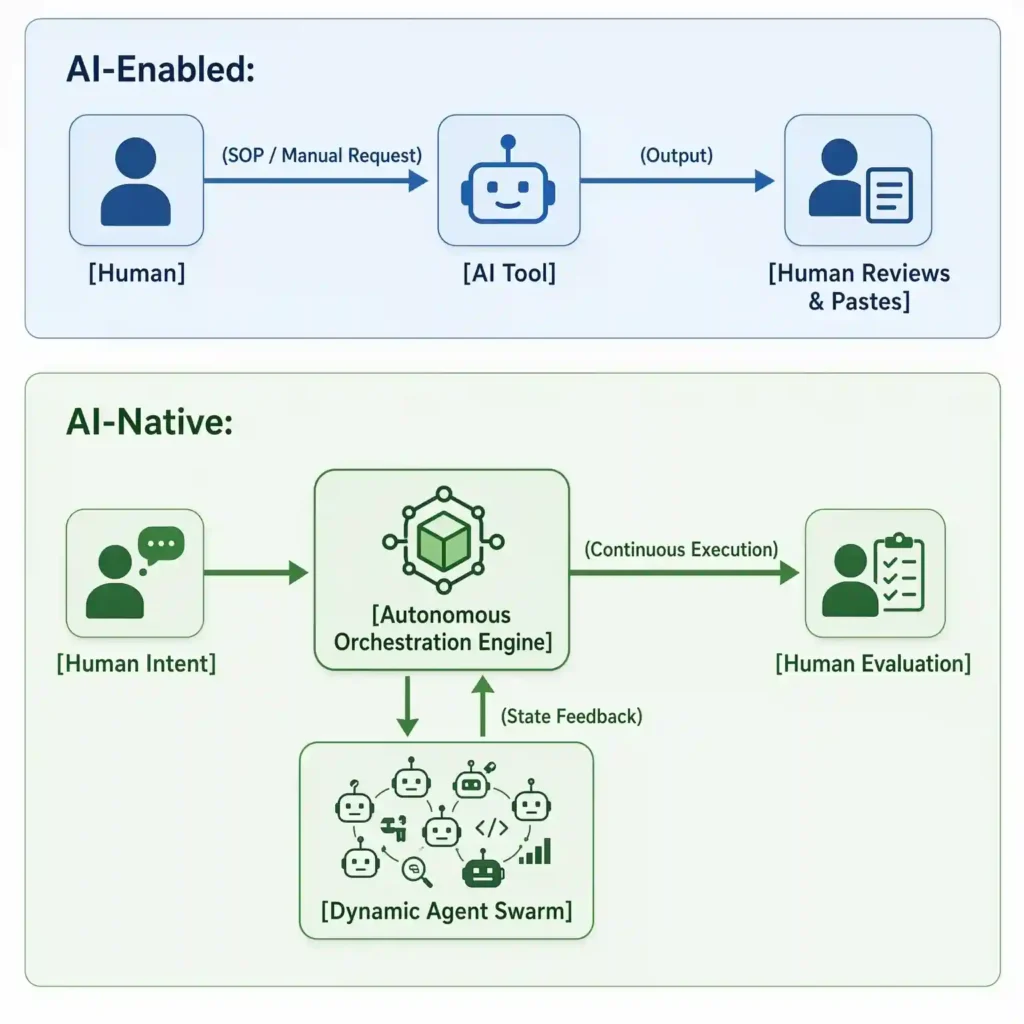
Most legacy enterprises treat AI as a digital patch—an intelligent plugin applied directly onto processes built during the Industrial Revolution. They take a 20th-century assembly line of human knowledge workers, hand each worker a chatbot, and expect an exponential breakthrough.
This dynamic mirrors the transition from steam power to electricity at the turn of the 20th century. When factories first adopted electric motors, they simply swapped out their central steam engines for electric ones, keeping the complex system of shafts, gears, and pulleys intact. Productivity barely moved.
Real industrial breakthroughs happened only decades later, when engineers realized that electricity allowed power to be distributed anywhere. They dismantled the centralized shafts, flattened factory floors, and built unit-drive assembly lines.
An AI-enabled organization puts an electric motor on a steam-age driveshaft:
- It treats AI as an interactive desktop assistant (Copilot).
- It preserves rigid, linear Standard Operating Procedures (SOPs).
- It measures success by incremental human time savings (e.g., “saves 15 minutes per document”).
An AI-native organization redesigns the factory floor around decentralized intelligence:
- It treats AI as an autonomous, probabilistic operating substrate.
- It replaces static SOPs with dynamic, self-optimizing agentic workflows.
- It measures success by business leverage—the ratio of organizational output to human headcount.
The Anatomy of an AI-Native Organization
Becoming AI-native requires a clean-sheet redesign of how an enterprise captures context, makes decisions, and coordinates work. According to the foundational AI-Native Organization Model, an AI-native enterprise is structured around four architectural pillars.
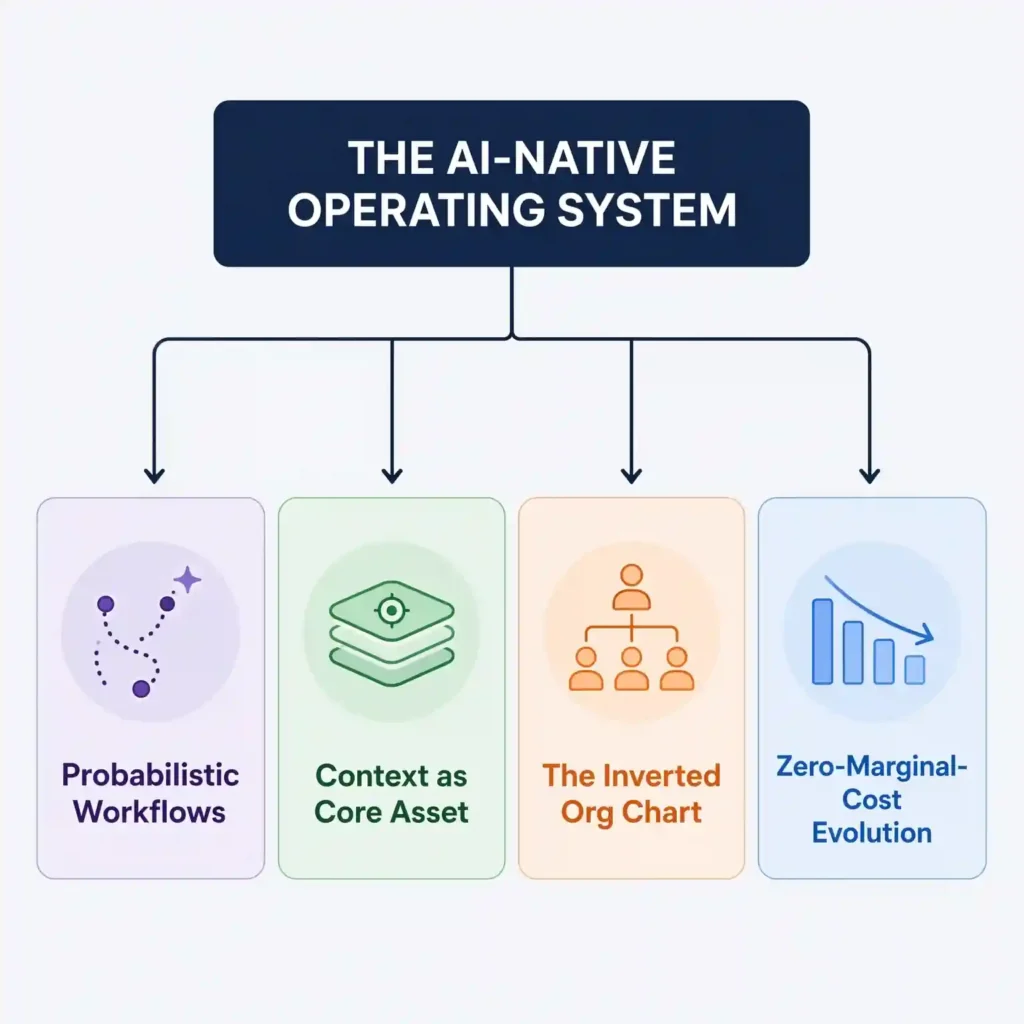
Probabilistic Workflows over Deterministic SOPs
Traditional organizations run on deterministic tracks. A human writes an SOP: “If Condition A occurs, route ticket to Department B, fill out Form C, and wait 48 hours for Approval D.” These rules are brittle, expensive to maintain, and fail the moment edge cases emerge.
An AI-native organization runs on probabilistic execution frameworks. Instead of hardcoding every intermediate step, human leaders define:
- The desired strategic outcome (The Intent).
- The boundary constraints (Safety, Compliance, Budget).
- The evaluation metric (The Grading Function).
Autonomous agents then dynamically plan, execute, critique, and adjust their own paths to reach that goal. If an obstacle arises, the system doesn’t grind to a halt waiting for a bureaucratic triage meeting; it generates alternative execution paths, tests them in parallel, and converges on the optimal solution.
Context as the Primary Asset
In a traditional enterprise, corporate knowledge is fragmented across Slack channels, hidden Notion pages, unrecorded Zoom calls, and the private intuition of senior employees. This is dead context.
AI-native organizations recognize that raw model intelligence is an external commodity. The only proprietary moat an enterprise possesses is its operational context—its real-time institutional memory, specialized datasets, customer interactions, and domain heuristics.
In these companies, context is not buried in static PDFs. It is engineered into dynamic retrieval graphs, semantic memory layers, and active vector indices. When an agent spins up to execute a task, it doesn’t operate in a vacuum; it instantly retrieves the company’s collective history, brand tone, regulatory boundaries, and past failure modes.
The Inverted Org Chart: Humans as Evaluators, Not Routers
In a conventional corporate hierarchy, middle managers act as human routers: they receive information from the top, break it down, route it to subordinates, collect the results, and pass them back up.
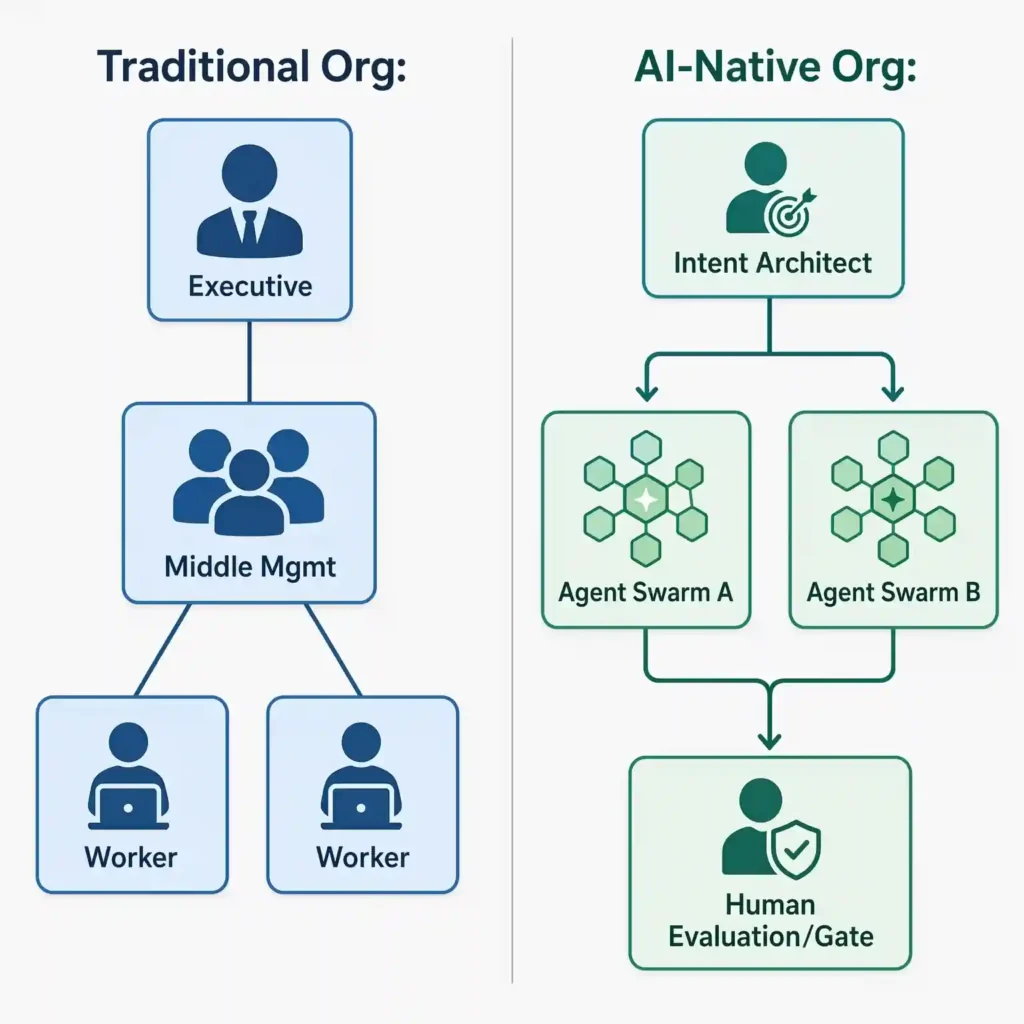
The AI-native organization flattens and inverts this hierarchy:
- Humans operate as Intent Architects and Evaluators. They define high-level strategy, set ethical and brand boundaries, handle rare high-stakes exceptions, and judge output quality.
- Agents operate as the Execution Matrix. They handle cross-functional synthesis, initial drafts, deep data audits, software scaffolding, and multi-system updates.
A single product manager in an AI-native firm does not manage a backlog across six engineering sprints. They direct a team of specialized AI agents that write the code, run regression tests, generate documentation, and prepare staging environments in hours rather than months.
Zero-Marginal-Cost Evolution
Every time a traditional company scales its customer base or product line, its operational complexity grows super-linearly. More clients mean more support reps, more managers, more sync meetings, and inevitably, slower execution.
An AI-native organization is engineered for zero-marginal-cost scaling. When the system solves a novel problem once, that solution is instantly codified into the organization’s shared memory. The entire company becomes smarter simultaneously.
The business scales its operations exponentially while keeping its core human team lean, focused, and unburdened by administrative overhead.
Ground Truth: How AI-Native Operates in Practice
To make this concrete, let’s contrast how core enterprise functions operate across both paradigms:
| Enterprise Domain | The AI-Enabled Approach | The AI-Native Approach |
|---|---|---|
| Software Development | Engineers write code manually; use GitHub Copilot for auto-complete and syntax suggestions. | Humans define system architecture and acceptance tests. Multi-agent swarms generate code, run self-healing tests, and submit verified PRs. |
| Customer Operations | Static decision-tree chatbots that deflect basic queries and route everything else to human tiers. | Context-aware agents with full tool-calling access resolve end-to-end inquiries (refunds, API integrations, debugging) autonomously. |
| Strategy & Market Intel | Analysts spend weeks gathering market data, formatting spreadsheets, and building PowerPoint decks. | Continuous ingestion of market signals, competitor releases, and internal telemetry synthesized into real-time operational models. |
| Talent & Knowledge | Onboarding takes months of reading static wikis and shadowing senior team members. | New hires query an institutional nervous system that possesses complete historical context and codebase reasoning. |
The Incumbent’s Dilemma: Can Legacy Companies Transform?
Transitioning from an AI-enabled enterprise to an AI-native organization is not an IT challenge. It is an organizational design challenge.
The greatest hurdle facing incumbents is Conway’s Law: organizations design systems that mirror their own communication structures.
If a company is organized around functional silos (Marketing, Sales, Engineering, Legal) that communicate through slow, ticket-based handoffs, simply introducing AI tools will merely accelerate the generation of tickets. It creates hyper-efficient bureaucracy.
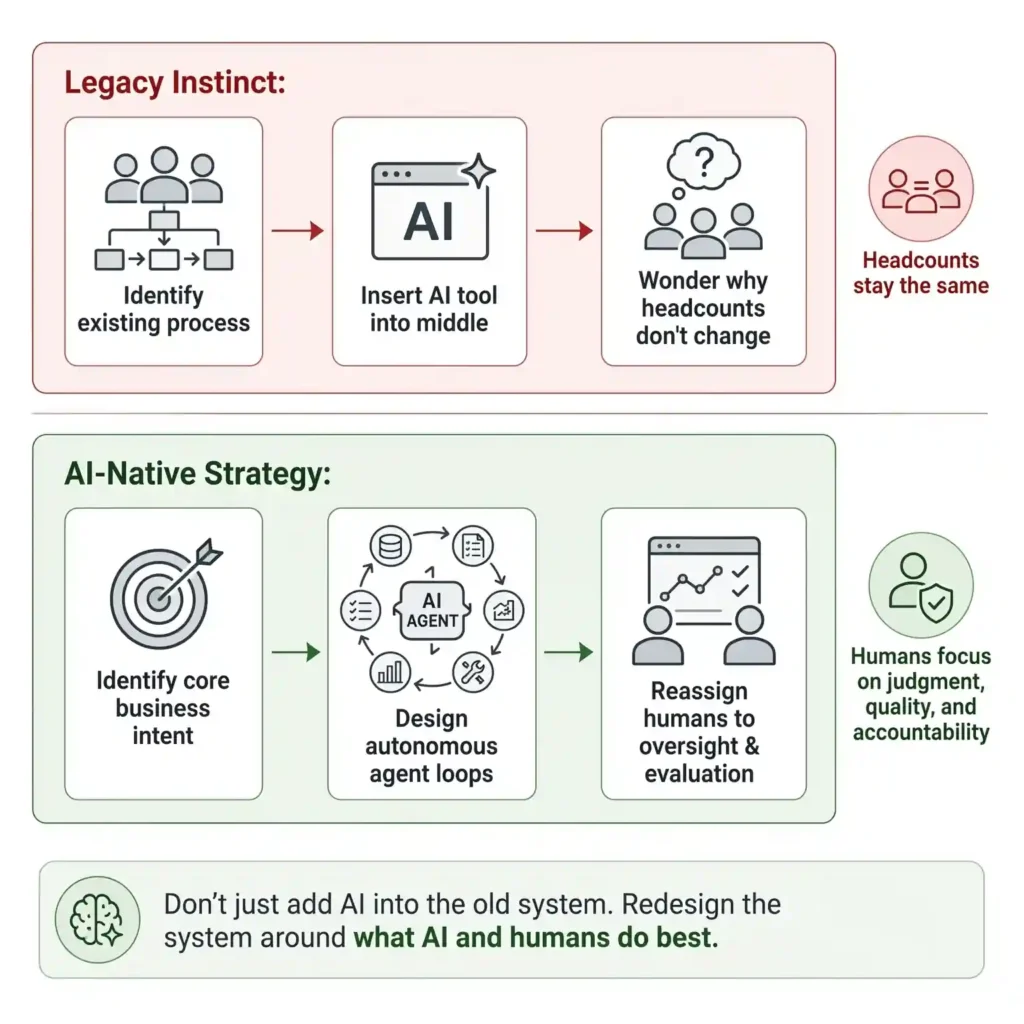
To break free from this trap, forward-looking leaders are abandoning the incremental “tool adoption” mindset and adopting three foundational principles:
Build Isolated AI-Native Sandboxes
Do not try to overhaul a 10,000-person division overnight. Instead, spin up autonomous, AI-native business units tasked with attacking existing lines of business from scratch. Give these teams modern architectural freedom: no legacy approval chains, no deterministic ticket queues, and a primary mandate to maximize output-per-human using agentic systems.
Redefine Key Performance Indicators
Stop measuring software adoption rates or hours saved. Instead, measure:
- Leverage Ratio: Revenue or output generated per full-time employee.
- Cycle Latency: The time elapsed from human intent definition to production deployment.
- Autonomous Resolution Rate: The percentage of end-to-end workflows completed without human intermediate routing.
Treat System Context as Corporate IP
Audit your data infrastructure ruthlessly. If your institutional knowledge is locked inside inaccessible SaaS silos, proprietary desktop drives, or unrecorded meetings, your organization cannot build an autonomous execution layer. Context curation must become a board-level priority.
The Architecture Is Your Moat
The foundational models powering modern artificial intelligence are evolving at an unprecedented pace. Today’s state-of-the-art model will be tomorrow’s cheap, open-source commodity.
If your corporate strategy relies solely on securing access to a specific foundation model or rolling out generic enterprise assistant tools, you have no sustainable advantage. Intelligence itself is becoming a utility, accessible to anyone with an internet connection and an API key.
Your true competitive advantage is not the AI model you rent. Your moat is the organizational architecture you build around it.
The winners of this economic era will not be the companies that bought the most AI seats. They will be the organizations that had the courage to dismantle the Industrial-Era assembly line, invert their hierarchies, and build a living, adaptive, AI-native operating system from the ground up.