
How AI-Inflated Resumes Are Breaking Hiring — and What Evidence-Based Screening Actually Looks Like
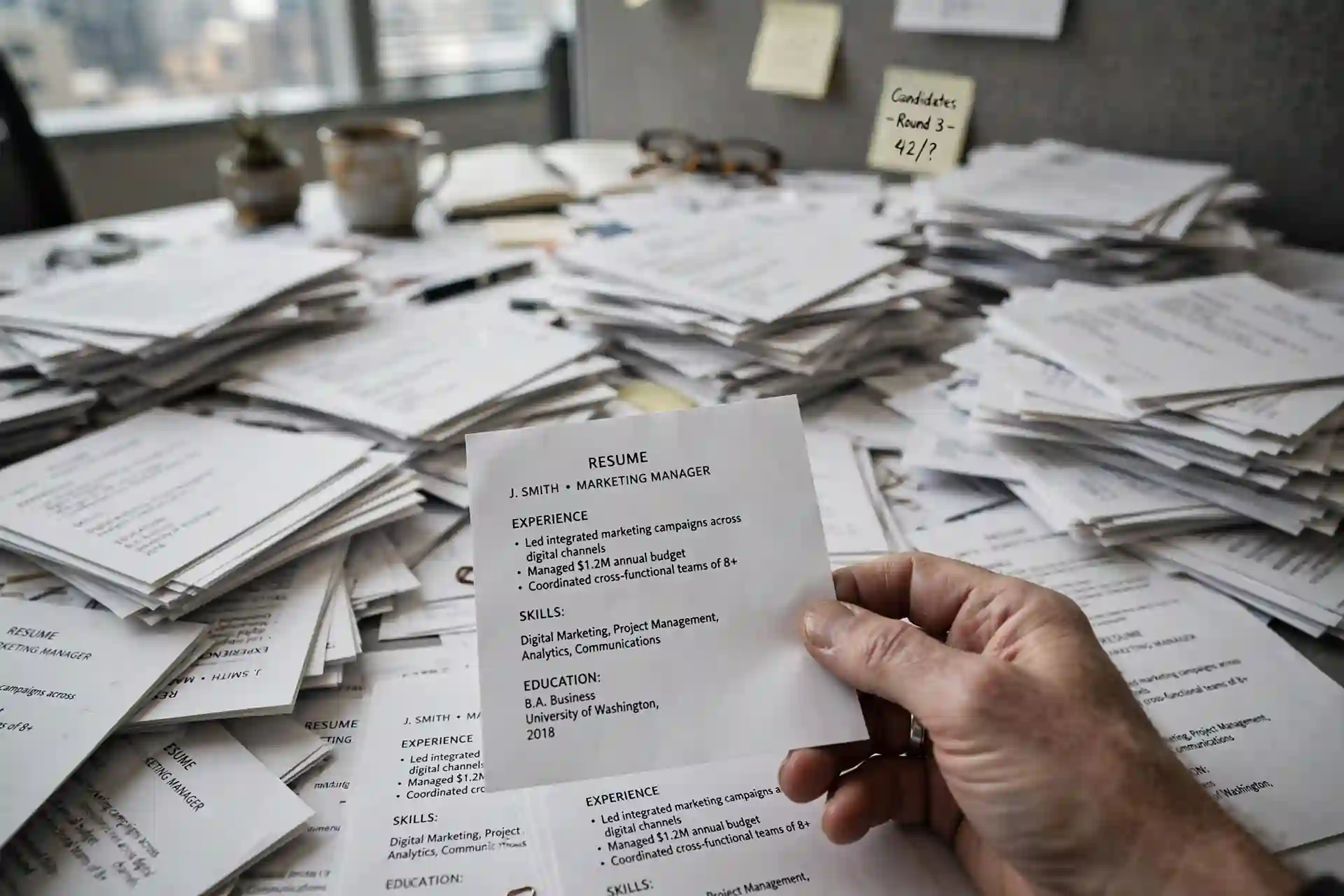
A recruiter at a mid-size tech company opens her inbox on a Monday morning. Her team has posted one role — an AI Product Manager position. By Friday, there are 312 applications. Every resume is pristine. Every bullet point is crisp, metric-heavy, and action-verbbed into perfection. Phrases like “AI-native thinker,” “drove 40% efficiency gains through LLM integration,” and “cross-functional AI transformation leader” repeat so often they start to blur. Welcome to the era of AI resume inflation.
She can’t tell who actually built something from who built a paragraph about building something.
This isn’t a hypothetical. This is the defining hiring problem of 2026. And if you’re a hiring manager, HR leader, or founder scaling a team right now, you already know it in your gut — even if you haven’t named it yet.
The problem isn’t too many applicants. The problem is that the signal is gone.
The AI Resume Inflation Arms Race
The numbers that define this moment are stark.
82% of hiring managers are now concerned about candidates using AI in job applications. And they should be: 72% of job seekers have used ChatGPT to write cover letters and 51% have used it for resumes. Meanwhile, 82% of companies now use AI to review those very same resumes — screening with the same technology that candidates are using to game the process.
The result is a closed loop of artificial polish. Candidates use AI to write. Companies use AI to screen. Neither side is reading signal anymore; both are processing noise.
AI-generated applications have introduced a dangerous new variable: systematic AI resume inflation. Research shows roughly six in ten hiring managers believe AI-created resumes consistently make candidates appear more qualified than they truly are.
The downstream consequences of that belief mismatch are not theoretical. More than a third of employers (37%) have terminated multiple workers after discovering that actual skills fell short of what their AI-enhanced resumes promised. Another quarter (25%) have made at least one such termination.
Think about what that means for a moment. Companies are not just rejecting bad resumes. They are hiring people, onboarding them, integrating them into teams — and then discovering the gap. According to the U.S. Department of Labor, a bad hire costs up to 30% of the employee’s first-year salary. According to LinkedIn, 85% of HR professionals report that a single bad hire negatively impacts the morale and productivity of the entire surrounding team. The financial damage is visible; the team damage is invisible and longer-lasting.
Here’s the paradox of 2026: job applications are up 182% year over year, but interview rates haven’t increased proportionally. More volume. Less signal. Higher cost per mistake.
Why Traditional Tools Lose to AI-Generated Resumes
The instinct, when signal degrades, is to add more screening layers. Better ATS. AI detectors. Stricter keyword filters. This instinct is understandable. It is also, largely, wrong.
ATS rewards keyword density, not capability. It was designed to process high-volume applications faster, not to verify that the person who wrote “built an AI pipeline” actually knows what a pipeline is. According to Gem’s 2026 Recruiting Benchmarks Report, only 0.5% of applicants receive an offer — meaning recruiters are processing 200 applications for every hire. The same report found recruiter workloads climbed 93% year-over-year. The machine is working harder. The signal quality hasn’t improved.
AI detectors are unreliable — and potentially discriminatory. A 2023 Stanford study showed GPTZero misclassified 61% of TOEFL essays as AI-generated, a finding that drove broader concern about non-native English speakers. If similar bias carries into the hiring detectors that 14% of teams now run, the disparate-impact risk — legal as well as ethical — is significant. You could be systematically screening out qualified candidates from underrepresented backgrounds while waving through fluent AI-generated mediocrity.
And human reviewers aren’t riding to the rescue. At scale and speed, polish beats substance every time. A beautifully formatted, AI-optimized resume with confident numbers will always outperform a messier document from someone who actually did the work.
The deeper problem runs beneath all of this. The resume was always a proxy instrument. It has always measured a candidate’s ability to present their experience, not their actual competency. AI resume inflation didn’t create the core problem, but it made it catastrophically worse, faster.
Stop Asking the Wrong Question
Most hiring processes in 2026 are built around a single implicit question: did this person write a good resume?
That question is now unanswerable — and also irrelevant.
The right question is: can this person demonstrate actual competency before they’re hired?
This isn’t a semantic distinction. It’s a structural one. It requires rethinking what counts as evidence at each stage of your funnel.
The concept gaining traction among serious talent leaders is Evidence of Competency (EoC) — a deliberate shift from credential-screening to capability-verification. EoC means that before a candidate reaches a hiring committee, they have produced some form of output that can’t be delegated, fabricated, or polished into existence overnight. A third-party verified certification. A portfolio artifact tied to a real deliverable. A live task completed in a room where they can’t ask ChatGPT. A reference who can speak to specific work, not adjectives.
This isn’t radical. It’s how every high-stakes profession has always worked. A surgeon doesn’t get hired based on how well they describe their surgical philosophy. They get assessed on board certification, observed performance, and case-specific track record. The question is why we abandoned this logic the moment “knowledge work” went digital — and why we keep abandoning it when AI makes it more urgent than ever.
The New Playbook: What Evidence-Based Screening Actually Looks Like
Move Verification Earlier, Not Later
The instinct is to verify credentials at the end of the process — once you’re already interested. Flip it. Make evidence of competency a gate at the top of the funnel, not a footnote before the offer letter.
To be clear, this doesn’t mean asking 300 applicants to complete a two-hour technical assessment on day one. That approach will only destroy your candidate experience and drive away top talent. Instead, it means introducing lightweight, AI-proof hurdles early on.
For example, ask for a verified certification link directly in the application form, or require a brief, three-minute asynchronous video explaining their approach to a specific workflow problem. Instead of reading 300 highly polished resumes and then asking 30 candidates to prove themselves, you use these lightweight gates to naturally filter the pool, allowing you to focus your time reading 30 submissions with actual, verified substance. Front-loading verification doesn’t add work. It redirects work to where it produces better decisions.
Define “AI-Native” Before You Hire For It
“AI-native” is not a keyword. It is a verifiable skill set — and most job descriptions treat it like a personality trait.
What does genuine AI fluency look like on the job? It means a candidate can identify where AI creates leverage in a specific workflow, integrate it responsibly, evaluate its outputs critically, and know when not to use it. That is categorically different from a candidate who can write a compelling paragraph about AI fluency.
Before you post a role requiring “AI-native thinking,” define what that means in your context. What does a competent person in this role actually do with AI tools on week one? On month six? If you can’t answer that, you can’t assess for it — and you’ll end up selecting the best-written resume, which is exactly how you got here.
Anchor Screening to Verifiable Third-Party Certification
Here is where the architecture of evidence-based hiring gets its non-negotiable foundation.
Just as a CPA designation tells a finance team something real about what a candidate knows, and a PMP tells a project office something real about methodology fluency, a rigorous, independently assessed AI certification creates an objective signal in a sea of AI-polished noise. It works precisely because it sits outside the candidate’s control to fabricate.
This is why industry-standard credentials are fast becoming essential. Programs like the AI Native Professional (AINP) Certification from APD Institute are pioneering this space. By providing an independently verified assessment of AI skills, it acts as a much-needed anti-counterfeit mechanism for AI-native talent. In a hiring market where candidates use AI to claim AI expertise, relying on a respected, third-party verified credential becomes a vital data point that can’t be reverse-engineered from a language model. When a candidate’s resume says “AI-native” and a standard like the AINP certification corroborates it, you’re no longer guessing. You’re reading evidence.
Build a Competency Evidence Checklist for Every AI Role
Here is a practical framework to apply immediately. For any role requiring genuine AI capability, your screening process should require at least three of the following four signal types before a candidate advances:
| Signal Type | What to Look For | Why It’s Hard to Fake |
|---|---|---|
| Third-party certification | AINP or equivalent rigorously assessed credential | Independently evaluated, not self-declared |
| Portfolio artifacts | Real deliverables, not descriptions of deliverables | Context and specificity resist fabrication |
| Live task assessment | A role-relevant problem solved in real time | Cannot be delegated in an interview room |
| Specific references | Referees speaking to specific AI-applied work | Generic praise is easy; specific project recall is not |
The key word in every row is specific. Specificity is the natural enemy of AI resume inflation. Ask for it relentlessly.
The Systemic Warning: AI Screening AI Produces a Hollow Workforce
There is a larger risk lurking beneath the individual bad-hire story. If companies screen with AI for candidates who game the process with AI, and no human ever stress-tests the actual underlying capability — the entire hiring pipeline produces a workforce that sounds competent but isn’t.
SHRM’s March 2026 State of AI in HR report found that 39% of organizations have adopted AI in HR. Among those using AI, 87% reported efficiency improvements — but efficiency and quality are not the same outcome. Processing 300 applications faster is not the same as identifying the 3 candidates worth hiring.
Forrester Research estimated in its 2026 “Future of Work” report that 55% of employers regretted laying off workers for AI-related reasons. The pattern is revealing: companies rushed to replace human judgment with AI-driven efficiency, discovered the gap between what AI can do and what the role actually required, and had to rehire. Six to twelve months pass and the AI has successfully managed 60% of the job duties, while unable to complete the remaining 40%.
The same dynamic plays out in hiring. Automate the screening. Miss the signal. Hire the wrong person. Pay three times over.
47% of companies say they are hiring more workers who can effectively use AI tools this year — which means the pressure to identify genuinely AI-capable candidates is only increasing. The stakes of getting the screening wrong are not staying flat. They are compounding.
A Word on Fairness
There is a counterargument worth taking seriously: AI writing tools have genuinely helped candidates from non-English-speaking backgrounds, people with disabilities that affect writing fluency, and applicants from under-resourced communities communicate their real capabilities more effectively. The positive effect of AI writing assistance was largest for non-native English writers, who made up over 80% of the sample in MIT/NBER research on the topic.
That is real and it matters. The goal of evidence-based screening is not to ban AI assistance. It is to stop treating the document as the evidence.
A screening process built around verifiable credentials, live demonstrations, and specific references is, in fact, more equitable than one built around resume polish — because it evaluates what someone can actually do, not how well they have learned to write about it. The candidate who struggles to produce a gleaming resume but can demonstrate real capability in a live task or point to a verified credential is exactly the person the current system is most likely to miss.
Evidence of competency doesn’t disadvantage real talent. It protects it.
The Signal Is Still There
Let’s return to the recruiter from the opening. She doesn’t need to read 312 resumes. She never did. What she needs is a process that gives her three non-negotiables before a candidate reaches her desk:
- A verifiable credential that can’t be gamed — one that tells her this person has been independently assessed on AI competency, not just self-described as having it.
- A live demonstration of the skill — a short, role-relevant task completed in real time, where the candidate’s thinking is visible.
- A reference who speaks in specifics — not “Sarah was an excellent communicator” but “Sarah built our prompt evaluation framework from scratch and reduced hallucination rates by 30% in the first quarter.”
None of this is complicated. All of it is deliberate. And in a market where 93% of recruiters plan to increase AI use in hiring in 2026, the companies that invest in deliberate evidence-based screening will not just hire better — they will hire faster, because they’ll stop wasting time on candidates who look right on paper and fall apart on the job.
The resume told you who they wanted to be.
The certification tells you who they actually are.
Is your company’s current hiring process AI-proof — or AI-fooled? The difference might be the next person you promote.