
Over the past few years, I have consulted for dozens of companies claiming to go “all-in on AI.” Regrettably, I’ve found that over 70% of them are trapped in a performative, “fake transformation”—essentially, an echo chamber of their own making.
The CEO announces a grand pivot to AI at the annual meeting, the IT department drops a fortune on computing power and tools, and company-wide training is rolled out with great fanfare. Yet, a year later, the financial statements show no revenue growth and no cost reduction. Meanwhile, employees are still grinding out the exact same overtime hours.
For many companies, their AI transformation is nothing more than slapping a modern GPS called “AI” onto a horse-drawn carriage. The carriage hasn’t magically turned into a car.

So, what exactly is a “fake AI transformation”? And how can you achieve genuine business results? Let’s start with a diagnosis.
Part 1: Diagnosis—Does Your Company Suffer from “Fake AI Transformation Syndrome”?
Take a hard look at your organization and see if it exhibits any of the following three classic symptoms:
Symptom 1: “Procurement equals Transformation”—Treating AI Like Office Supplies
Handing out ChatGPT accounts to all employees, or having the tech team integrate an LLM API, and immediately declaring to the world, “We are now an AI company.” The reality: Core business processes remain entirely untouched. Employees merely gain access to a glorified search engine. The moment they face complex challenges requiring deep integration with actual business scenarios, they instinctively retreat to their trusty old spreadsheets and legacy systems.
Symptom 2: “The IT Department’s Solo Act”—A Severe Disconnect Between Business and Tech
The AI transformation devolves into a vanity project built by the tech department behind closed doors. The tech team dismisses the business units as clueless for not understanding LLMs (Large Language Models, the supercharged AI brains trained on massive datasets). Conversely, the business side views the tech team’s deliverables as “expensive toys” that completely fail to solve the real, everyday pain points customers complain about.
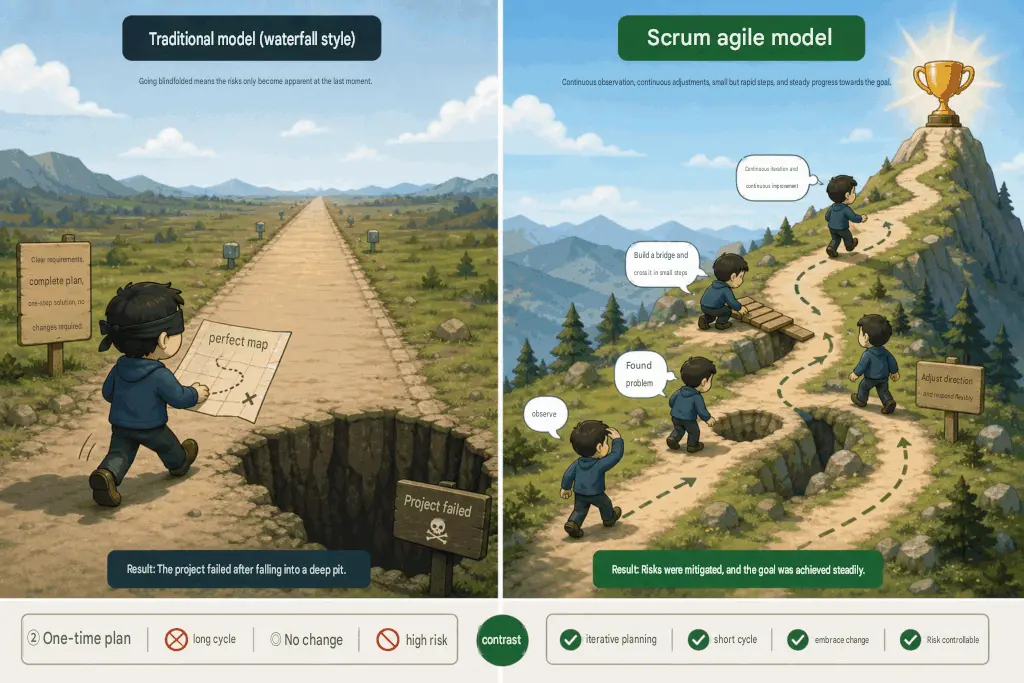
Symptom 3: “Approaching AI with a Waterfall Mindset”—A Year to Plan, Obsolete on Launch
This is rampant in traditional enterprises. Executives attempt to manage AI projects using a “Waterfall mindset” (a traditional, unidirectional project management approach requiring every detail to be planned upfront with no looking back). They spend three months drafting hundreds of pages of requirements and another six months in development. The result? Before it even goes live, LLM technology has already evolved, or a competitor has launched a far more agile solution. Their massively expensive master plan is instantly reduced to scrap paper.
Part 2: Root Cause Analysis—Why Do Fake AI Transformations Happen?
From an Agile coach’s perspective, companies fall into these traps because their underlying mental models haven’t fundamentally shifted.
First, a fear of the difficult path leads to “local optimization.” Overhauling core business processes is incredibly painful. It goes far beyond technology; it disrupts power dynamics, resource allocation, and organizational structures. Consequently, companies instinctively opt for the path of least resistance: buying a few tools and hosting a couple of training sessions. This creates a facade of “we are taking action,” which merely masks a profound strategic laziness.
Second, a lack of “Empiricism.” In the Agile Scrum framework, the core philosophy is Empiricism: acknowledging future uncertainty and making decisions based on real-world observation and trial-and-error, rather than arbitrary predictions. Traditional software development is deterministic (if I input A, I will always get B). AI, however, is non-deterministic and operates as a black box (ask the AI the exact same question, and you might get a different answer every time). Attempting to control a fundamentally unpredictable technology using traditional, “predictive” management frameworks is a guaranteed recipe for disaster.
Part 3: The Prescription—Winning the Real AI Battle with Agile Scrum Thinking
A genuine AI transformation must begin with restructuring the organization and its ways of working. Here are three actionable guidelines for the trenches:
Solution 1: Adopt a PO Perspective to Identify Genuine “High-Value Scenarios”
Stop sitting in conference rooms asking, “What can we do with AI?” Instead, put on the hat of a PO (Product Owner—the person responsible for defining the product and maximizing its business value), and ask: “What is the single biggest pain point our customers face right now? Can AI solve it more cost-effectively and efficiently?”
Don’t adopt AI just for the sake of adopting AI. If a problem is easily solved by a traditional automation script, do not bring a sledgehammer to crack a nut by plugging in an LLM. That will only skyrocket your costs unnecessarily.
Solution 2: Form a True Cross-Functional Special Ops Unit (Scrum Team)
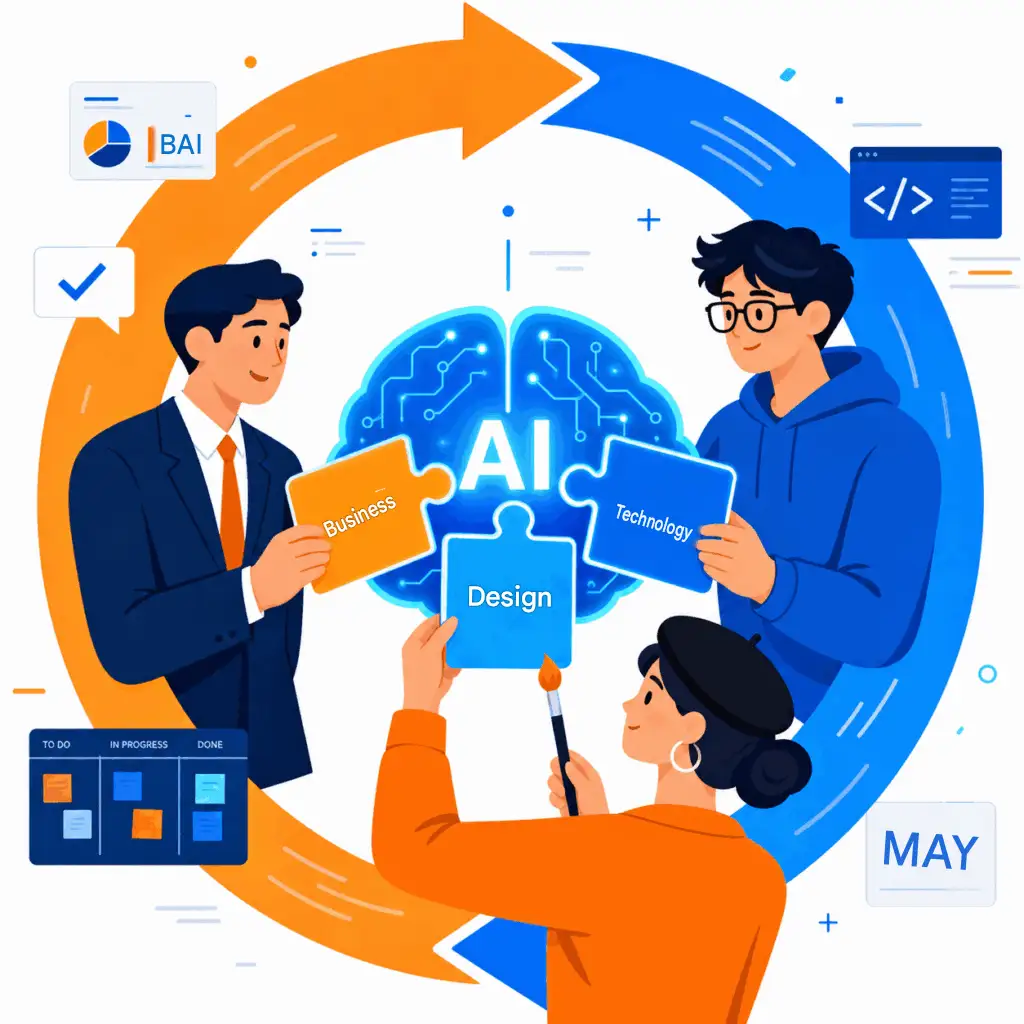
Tear down the silos! Stop the cycle of the business side throwing requirements over the wall for IT to develop. You need to assemble a self-contained Agile Scrum Team: bring those who deeply understand the business lines, those who master AI tech, and those who know UI/UX together at the exact same table. They should no longer report project progress to their respective department heads; instead, they share collective accountability for the success or failure of this specific AI product.
Solution 3: Embrace Sprints and Validate Fast with an MVP
Stop holding out for a “big bang” release! In the AI Era, speed is survival. Break down those grandiose annual roadmaps into rapid, 1-to-2-week Sprints (short, time-boxed working iterations).
In your very first Sprint, the goal is to deliver an MVP (Minimum Viable Product—the most basic version built at the lowest cost to validate a core hypothesis).
A Real-World Case Study: I once coached an e-commerce company that wanted to build an “AI Smart Customer Service” bot.
The Traditional Approach: Spend two weeks writing requirements, a month sourcing a vendor for a private LLM, and another two months training data. They finally launch, only to realize customers flat-out refuse to use it because the bot’s responses are completely robotic and rigid.
The Agile Approach: The team wrote absolutely zero code in the first week. They simply used the standard web version of ChatGPT. A customer service rep manually copied customer queries into it, used fine-tuned prompts to generate answers, and then manually sent those answers back to the customer. Using this remarkably scrappy, semi-automated method for a week, they discovered that AI could effectively resolve 60% of inquiries. Crucially, they also identified exactly which types of questions triggered AI hallucinations. Only after validating both the business value and the risks did they start writing actual code in week two to integrate the systems.
That is the essence of Agile: buying the most authentic business feedback at the absolute lowest cost.
Part 4: Conclusion—AI is Not Magic; It is an Amplifier
The most common pitfall for companies undergoing an AI transformation is treating AI as a “magic wand” that will effortlessly cure all management and business ailments.
As a battle-tested veteran in the product and Agile space, I want to share a brutal truth: AI is merely an amplifier. If your underlying business logic is sound and your organization is agile, AI will give you wings. But if your internal management is a mess, your departments operate in silos, and your product lacks competitiveness, AI will only amplify that chaos—enabling you to manufacture meaningless industrial garbage at an unprecedented speed.
A true AI transformation has never been solely about rewriting code or upgrading computing power; it is about rewiring the organizational brain and reinventing the way you work. Stop obsessing over how many AI licenses you’ve purchased, and start looking at how many real business pain points you’ve actually solved.